

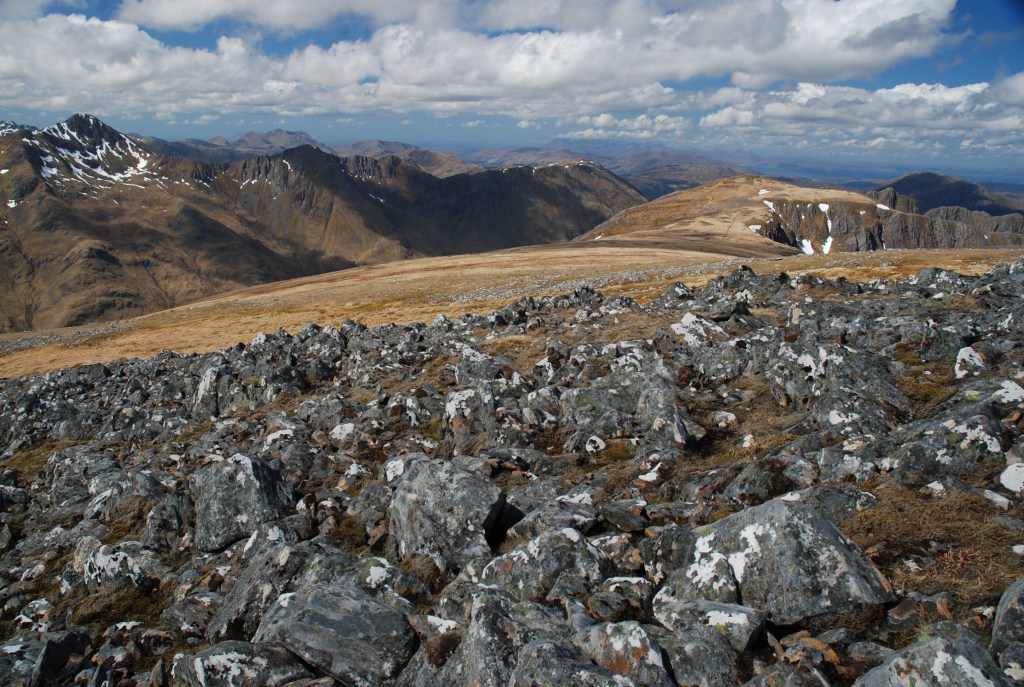
It’s some time after 5 o’clock in the afternoon and we’re up at 2500 feet on the bealach between the Saddle and Sgurr na Sgine. Funnily enough, it’s all downhill from here. But I’m not so keen on the next bit, which involves picking our way across a boulder field, the flattened remains of a deceased wall, a rocking, roiling experience like being on a ship’s deck. But it ends, as these things always do. And the rain starts. We stop to put on some more clothes, looking down on a completely new vista. Kintail. It is a giddy sight, the ridge falling away from us, so many mountains on all sides. But the path is straightforward enough.
It’s exciting to imagine being at the end of this first phase, to have completed sixty-seven and a half miles in four days. And what miles they were! I want to tell my mum. It doesn’t matter that I’m close to being venerable myself, I still want her to be proud of me. And, if I’m honest, to tell her that, for better or worse, I truly am following my own path now. I know she blamed herself for not being able to protect us from the more toxic elements of her and dad’s relationship. ‘Were you happy when you were young?,’ she once asked me a few years ago, in the kitchen of the house she’d bought entirely to please herself after dad died.
I hadn’t expected the question and took a second to think about it, but not so long as to rub anything in. ‘I had a happy childhood,’ I told her. And it’s true, though those good memories mostly involved being with my siblings and the friends we had up and down the street, making up little plays, doing who knows what for hours in the garden, disappearing into our own little world, as well as the ones I inhabited through the books that were my constant escape. And then, because it was a serious question, I mumbled something about it being more difficult when I got to being a teenager.
I honestly don’t think it matters. It’s the here and now that counts, though I know the past is irresistibly attached to the present, whether we recognise its influence or not. We’d worked things out between us, mum and I, and I was the richer for it. And then covid struck and, to begin with, I couldn’t actually see her, though we – like families up and down the country – began a weekly zoom call, mum and her three children. In the second lockdown, she formed part of my family bubble and I drove across to Dunfermline every week, texting her to say I’m on my way. With cake (from the café in our village) that became the kind of standing joke most families have but which they should probably keep to themselves.
She survived the pandemic remarkably well and even took covid itself in her stride, despite her lung condition. But she was in a lot of pain, mostly from the arthritis that went with her bronchiectasis. Even before covid, when we went to Florence in 2019, she couldn’t move at any speed and found the hard pavements and the crowds too much for her. A year later, when we couldn’t get on a plane, we headed an hour north to Dunkeld for a week in a luxury hotel, her and dad’s careful investments giving her a level of affluence that she sometimes liked to throw around. But she couldn’t enjoy it, the pain sometimes making her gasp, forcing her to lie down. She absolutely hated it.
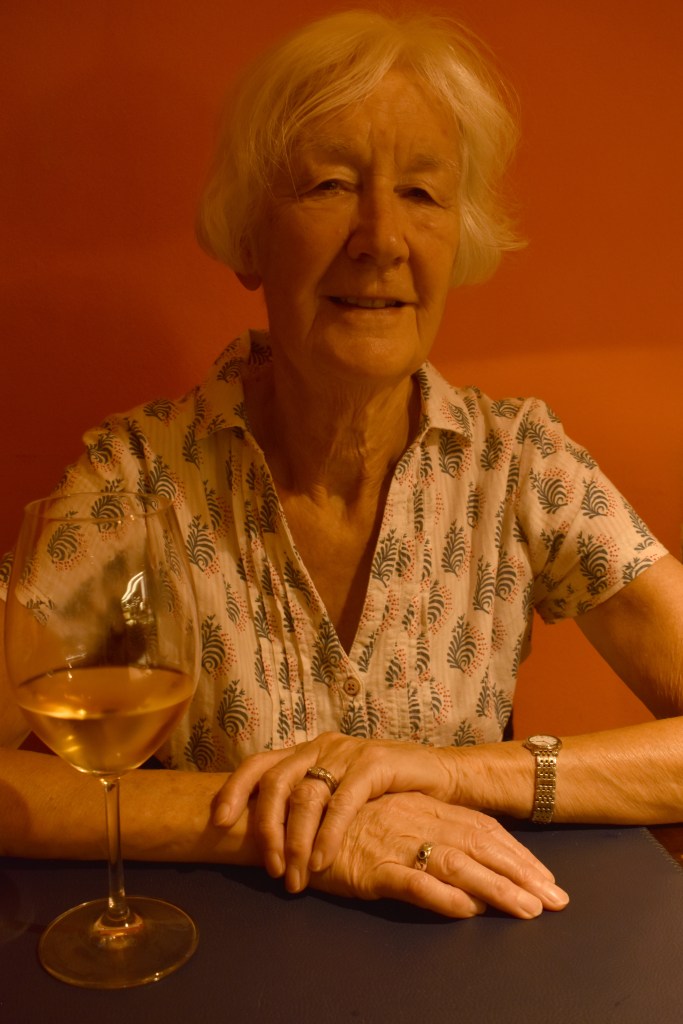
She got a bit better. ‘I really want to take you to Madeira,’ she said. ‘I think you’d love it.’ I knew she loved it. One of the few photographs in the house, which she kept in her bedroom, was of a levada taken many years before when she went with dad. So we booked a trip for October 2022. The night before, I felt unwell. ‘You’d better test yourself,’ Nick advised. I was positive for covid. I knew how much the trip meant to her, for there were surely not many left. I phoned, so choked up with tears she thought I was laughing.
In the spring of 2023 she could hardly get out of bed. When she did, she seemed to have shrunk, shuffling to greet me like the old woman I couldn’t really believe she’d become, though with hands outstretched and a smile of utter joy lighting up her face. I fussed around her, worrying that if she fell or became really ill, how would any of us know to do something in time? We talked about sheltered accommodation, where at least there would be people to look out for her, but the one we visited felt like the waiting room for a care home. Neither of us wanted that. I asked her to get one of those alarms that would automatically phone me and she eventually agreed, though only because I insisted and she didn’t want me to worry. She’d do it for me, she stressed, not because she actually needed it. Whatevs.
By the summer, she had rallied again. As we sipped our coffee looking over her little back garden, she told me she wanted to stay in her house. I got the message, though I must confess I did selfishly wonder what this would mean for my own caring responsibilities. And the trip to Madeira was back on the agenda. It took only twenty minutes to choose and book the holiday and another two hours to arrange her travel insurance.
This time we made it through the night before. But on the morning of our flight, just as I was about to leave to pick her up, she phoned. ‘I’ve got a really sore tummy. It started last night and I’ve been sick, though not very much.’ Uh huh. I could feel the need for me to take charge careering down the phone, but she wasn’t telling me she couldn’t go. ‘I’ll pop into the chemist on the way over and see if I can get something for your tummy and we’ll take it from there.’ There’s nothing like kicking the can even slightly down the road.
But a decision had to be made, and soon. She was in the kitchen when I arrived and came out into the living room to greet me. I can still see her standing there, that look of quiet determination on her face that was just as unyielding as a teenager asked to hand over their phone. ‘I want to go.’
I nodded. We both knew this would probably be the last time she went abroad, so I understood. And in the end, she was the only one who knew how she felt. ‘Are you sure you shouldn’t give the doctor a call?’ She shook her head. Doctors can insert an unwelcome degree of caution into such proceedings.
By the time we got to Edinburgh airport, she was feeling unwell enough to suggest we asked for assistance. Though it didn’t get us through security any quicker, we were given first class treatment in Madeira and sailed out to the waiting bus. I knew the travel would be tough for her anyway, and I could see she was having to work hard to hold it together on the plane. But as we sped towards Funchal she looked so happy to have made it, telling me that this expressway hadn’t been there when she and dad came before.
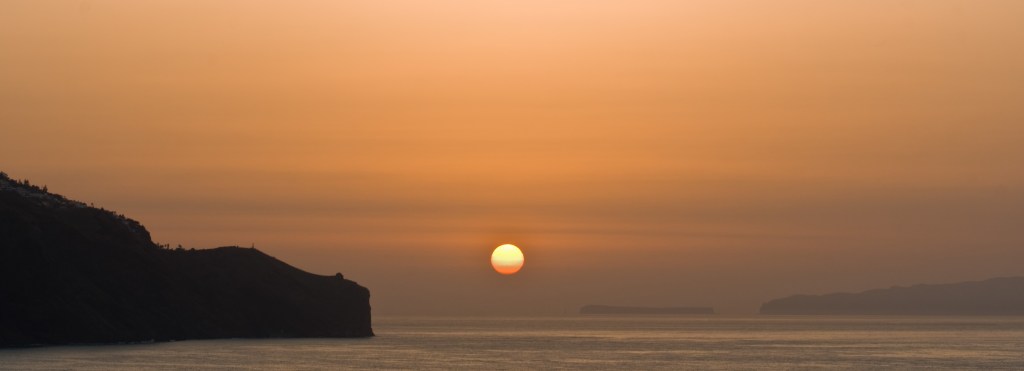
At the hotel, she got into bed as I put her things away. ‘Go and get something to eat,’ she commanded. ‘Okay. I’ll pop in later.’ When I did, she was fast asleep. Best thing for her, I thought, turning down the air con so it wouldn’t make so much noise. But in the morning, when I hoped I’d see her up and about, maybe sitting on the balcony, she was still lying in bed, face drawn. ‘I’ve had a terrible night. Hardly slept at all.’
I went to find some more stomach medicine from the chemist over the road. ‘We can just go home,’ I told her. ‘It’s no problem.’ She slept. I wandered along the seafront, came back, spent the afternoon with her, telling her about all the lizards I’d seen, reading out loud, stroking her hair. ‘Oh, Fi,’ she cried, ‘I just want to enjoy being in the sunshine with you.’ Me too, mum.
I left her to message my sister and brother to tell them she wasn’t well. And I phoned Nick, saying I didn’t really know what to do, though if she wasn’t any better by the morning, it was time to get a doctor. Grabbing something to eat, I headed back up to her room.
I called out to her as I went in, but there was no answer. And I could see she wasn’t in her bed. I checked the bathroom. Suddenly hopeful, I thought she might finally be out on her balcony getting some of that sun. But as I walked towards the sliding doors I saw her lying on the floor on the other side of the bed. Turning her over, I felt my mind shatter, part of me utterly calm, understanding what I was seeing, most of me a breathless wail of concentrated disbelieve.
The rest was surreal, a to-ing and fro-ing of doctors and police, all managed by the most caring hotel staff, holiday reps, hotel guests and, ultimately, a funeral director who gave me so much of himself because, as he said, he wanted to look after me, all alone in Madeira, as he would wish for a member of his own family. One doctor said it had been a heart attack, but the next disagreed. We still don’t know what killed her, but I suspect sepsis. Do I wish I’d called a doctor earlier that day? Of course. But it was almost certainly already too late and she would have died in hospital instead of in a hotel room in a place she loved.
I spent the next few months finding myself suddenly in tears, constantly wanting to press the rewind button. But that was a reaction to how she died, not the fact of her passing. She was 83 after all, and had at least been spared the inevitable deterioration that had already begun and would have robbed her of her precious independence. I hated clearing out her house, the place forever associated with that moment, crystal clear in my mind, when she’d asserted her right to choose her own destiny the morning we left. But when Nick and I went back to Madeira, a year after mum died, I found it cathartic. I let go of that visceral, debilitating sadness and the profound sense that I’d somehow failed her. I was even surprised by a momentary surge of anger at her for leaving me in such an abrupt, confusing way and which had no doubt been within me all along, smothered by the more urgent demands of sorrow and self-recrimination. And we left a part of her there, in the beautiful hotel garden, beneath a tree high above the sea, a dazzling sun to watch over her.
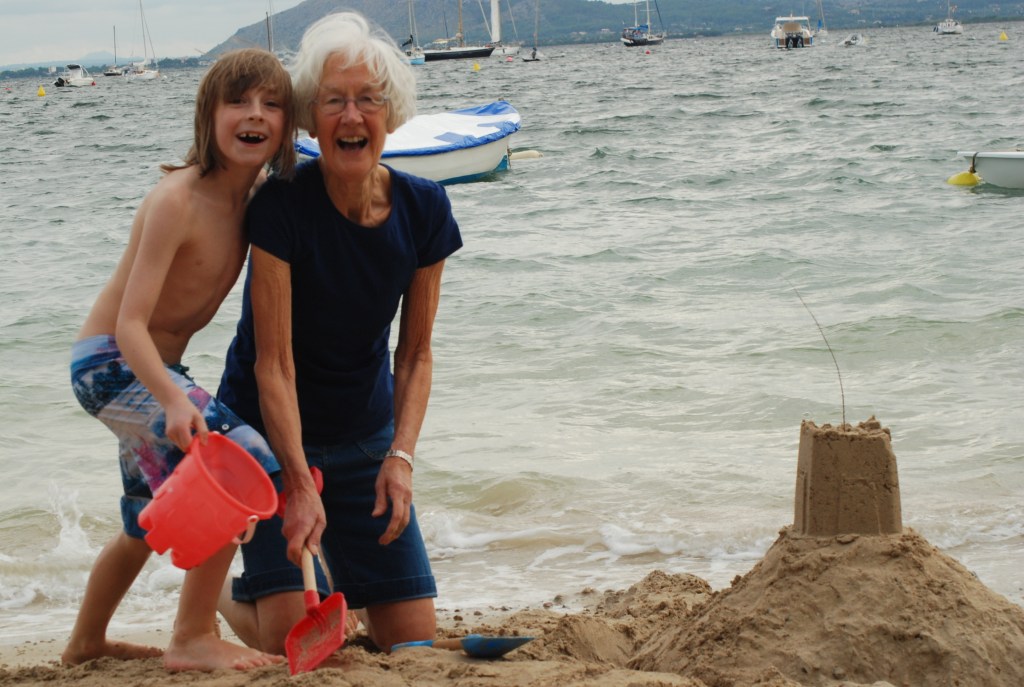
But losing the last of your parents is still a weighty moment, no matter how or when they go. In part, it’s the realisation that there’s no-one left to ask questions about your immediate family history, things you never wondered about until it’s too late. It also forces you to recognise the inevitable, but outrageous, fact that you are now a member of the oldest generation, no longer able to hide from death’s eternal list behind the one before. And, no matter how old you are, there is something giddy about the knowledge that you are truly on your own, the hand that guided you, for good or ill, however long ago and however much you’ve fought to be the master of your own ship, removed forever. But perhaps that hand is still there in my heart, gently reassuring, sometimes quizzical, but eternally proud.
We reach the bottom of the path and turn left to negotiate the flank of the ridge down into Coire Uaine where we pick up another path. Moving fast now, we’re eager to bring an end to the day, a smattering of birch and rowan welcoming us to the lower ground. The river Undalain whispers gently alongside us, more rock than water. We cross it easily, joining a proper Wade road that will take us to the campsite at Shiel Bridge.
‘Do you fancy getting some dinner at the hotel?’ Chrissie asks.
Oh boy do I fancy getting some dinner at the hotel. She’s on her phone immediately. OMG, a real live signal. She turns to me again once she’s finished. ‘We need to get there by 7.45. I reckon we’ll get to the campsite in about twenty minutes.’
There’s no way we’re going to miss that. I get into the groove. It’s a good road, rocky but broad and flat. I don’t need my poles any more. Humming to myself, I look ahead, enjoying the sight of a birchwood shivering in the gathering gloom.
And suddenly I’m falling. I think I caught my left foot on a rock and stumbled. Normally, my right foot would have caught me, but the weight of the pack is too much. Or my poles would have taken the strain, but I’m not using them. I am felled like a tree, the milliseconds of my descent etched in my memory, the look of alarm on Chrissie’s face as she turns round. I fall onto my left side, a sharp pain hitting me near my left armpit, muddy grit in my mouth.
There is silence for a brief moment. Then Chrissie rushes towards me.
‘I think I’m alright.’ Looking up at her, I feel like a beached turtle. She reaches down to help me onto my feet. I dust the grit off my face and my left forearm, which is bleeding, but that’s nothing a good wash won’t cure. I can still feel a sharp pain near my armpit, but it could have been a lot worse. ‘I think I got away with that,’ I tell her.
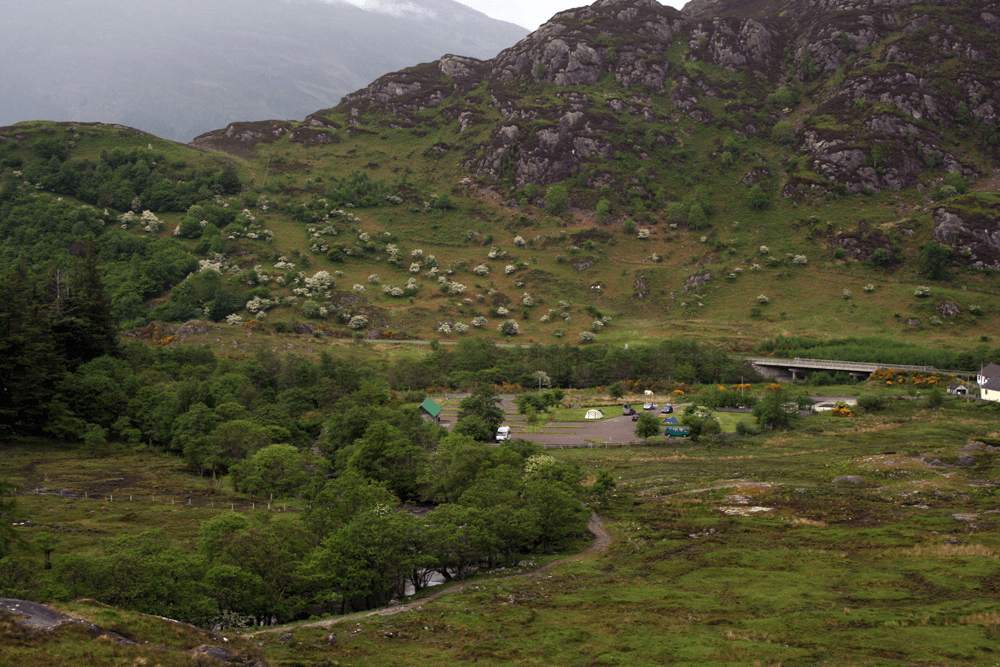
But we’re on a schedule. At the end of the woods a path winds its way down a steep gravel track. I take it canny, but I can see the campsite at the bottom, willing me on. It’s 7.15. We check in, choose our spots and throw up our tents in double quick time. I go for a swift wash of my face and arm. I haven’t got time to address the rest of me and can only hope a few layers of clothing will keep anything untoward from escaping. It’s 7.35. Without our packs we sail the mile along the road to the hotel, enjoying the warmth and hubbub inside as we push open the door.
No-one’s bothered about our appearance a few minutes late. I realise I’d been holding my breath on that one, prepared to go down on my knees to beg for our dinner. We’re settled at a table by the window in the bar, menus proffered, wine ordered. We can’t help grinning, the joys of civilisation tasting so much sweeter now. I feel as if I’ve known Chrissie for years, not just the eighteen hours or so we’ve spent together, so easy is her company. We chat non-stop, apart from when I’m digging into my salmon bruschetta, then an enormous fish and chips. I try not to cram it in, to savour the taste. I’m not sure I’m all that successful. It’s dark when we wander back. I’m sure I’m exhausted, but I don’t feel it yet. We say goodnight and I decide that any cleaning/tidying up/sorting out can wait till tomorrow. I climb into my sleeping bag. My legs are restless, but that’s perhaps not a surprise after such a long and arduous day. At last I fall deeply asleep.


Leave a Reply