

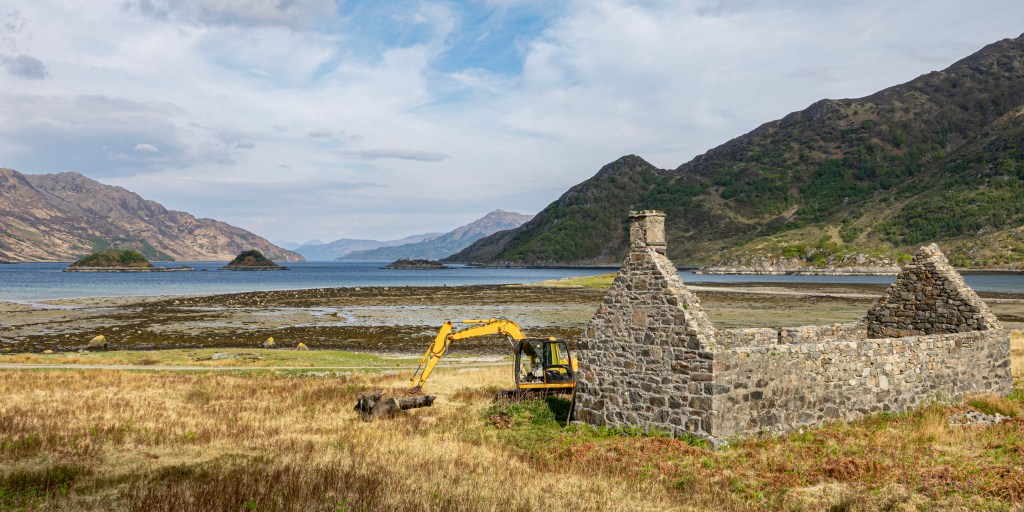
I turn right to climb up the first little hill beside another old building. It was a church in the nineteenth century, though the remains of desks and seats suggest it was used as a school at some point. There don’t seem to have been any windows in the side walls (there may have been some in the roof, which has disappeared). That’s probably a good thing. I can imagine if I was sitting there being taught at, I might find the urge to look out at the loch irresistible. And I imagine many of the children sitting there would have had fathers or brothers busy out on the water or nearby, which might also have proved distracting. I’m already distracted by the digger hard at work outside, trying to dislodge a great old tree trunk from out of the ground. Its grumbling roar lessens the higher up I climb until I’m left with only birdsong once more.
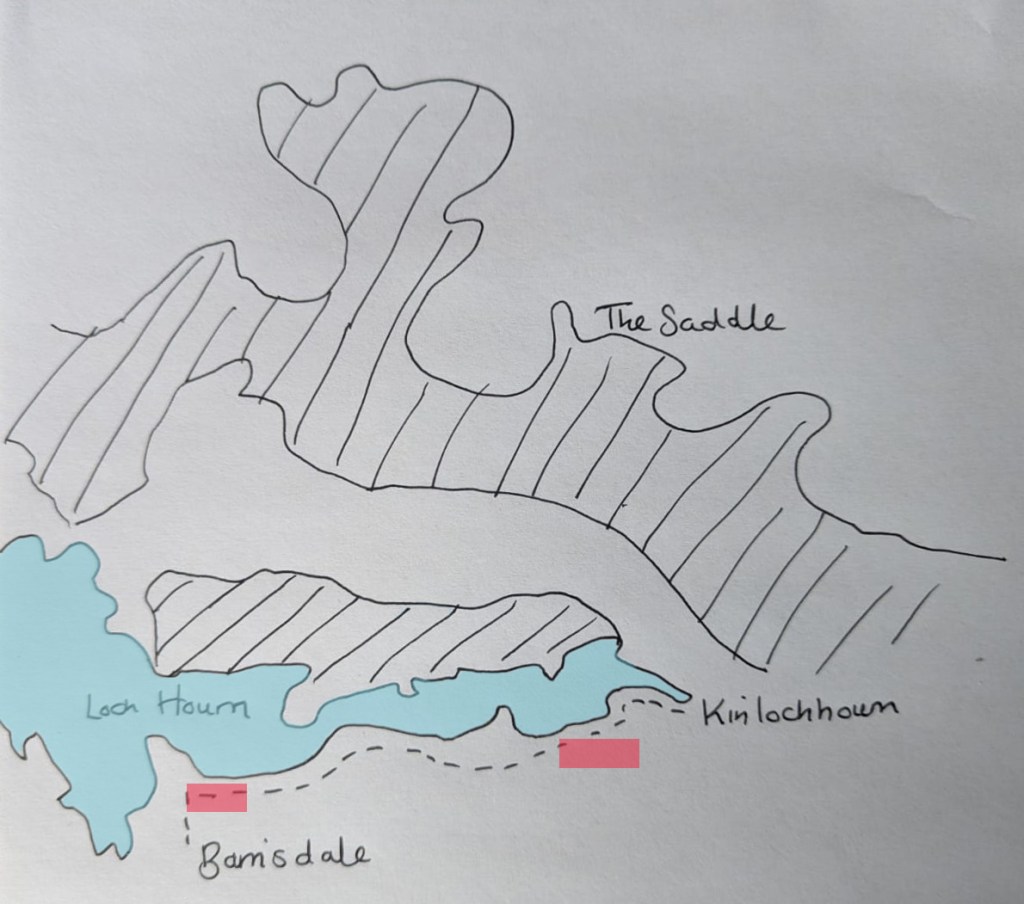
I’m walking east for seven or eight miles (you’d be surprised how many variations on the mileage there are online; the guidebook says eight) through moorland, patches of tough, clingy heather dominated by tussocky grasses. I’m glad of the stony path, despite the small trenches still full of water that are occasionally gouged out of it, for it would be a bit of a slog otherwise. I’m quite high above the water and already I can see tomorrow laid out serenely before me on the other side of the loch. In conditions like this, a comb-through of white clouds high above the summits, the way up and over Bealach Coire Mhàlagain is plain to see, the Saddle on the left looking much more substantial and impressive from this angle than the gently rolling ridge of Sgurr na Sgine.
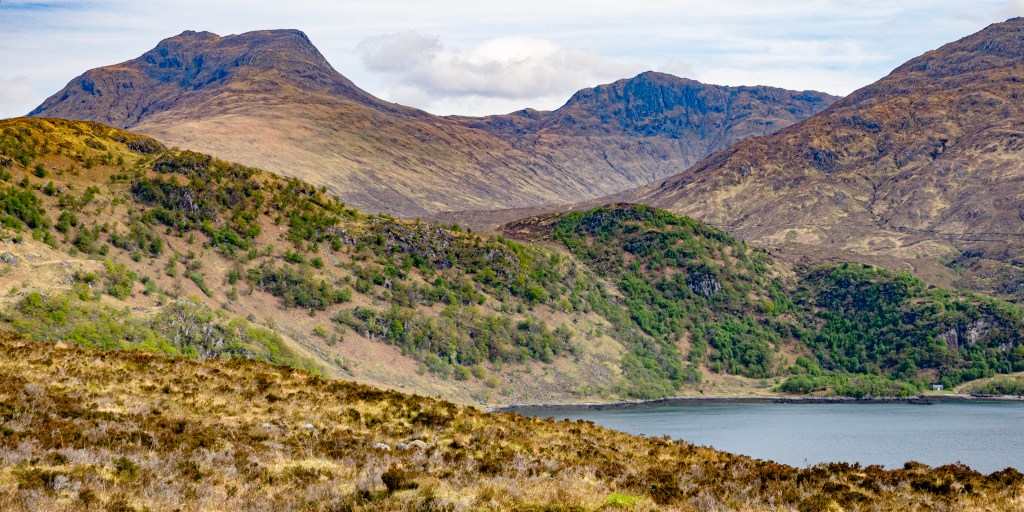
I press on, moving easily, my feet much less painful now I’ve dealt with my blisters. But I’ve got no chance of gauging my progress towards Kinloch Hourn, given that the map tells me the loch twists round towards the south-east, tucking the village away out of sight. I just wish I’d checked before I left civilisation when the café there is open. Apart from the undeniable attraction of real food, I hope to be able to phone Nick and Finn.
There were only two farms between Barrisdale Bay and Kinloch Hourn in the eighteenth century: Caolasbeg (which means ‘little channel’) and Skiary, wadset to Coll Mcdonell from Glengarry just like the townships on Loch Nevis.[i] I cross a burn and am soon above Caolasbeg, though there’s nothing left now to tell me it was once inhabited apart from fragments of stone walls criss-crossing the ground like the backbones of long, emaciated creatures submerged beneath the sward. In 1755 the tenant’s name was Allan Mcdonell. But soon the Commissioners began to wonder if renting to someone whose living depended on grazing animals was the best use of this particular land. For at neighbouring Skiary, finally, they had found something potentially valuable. But it was in a dreadful state.
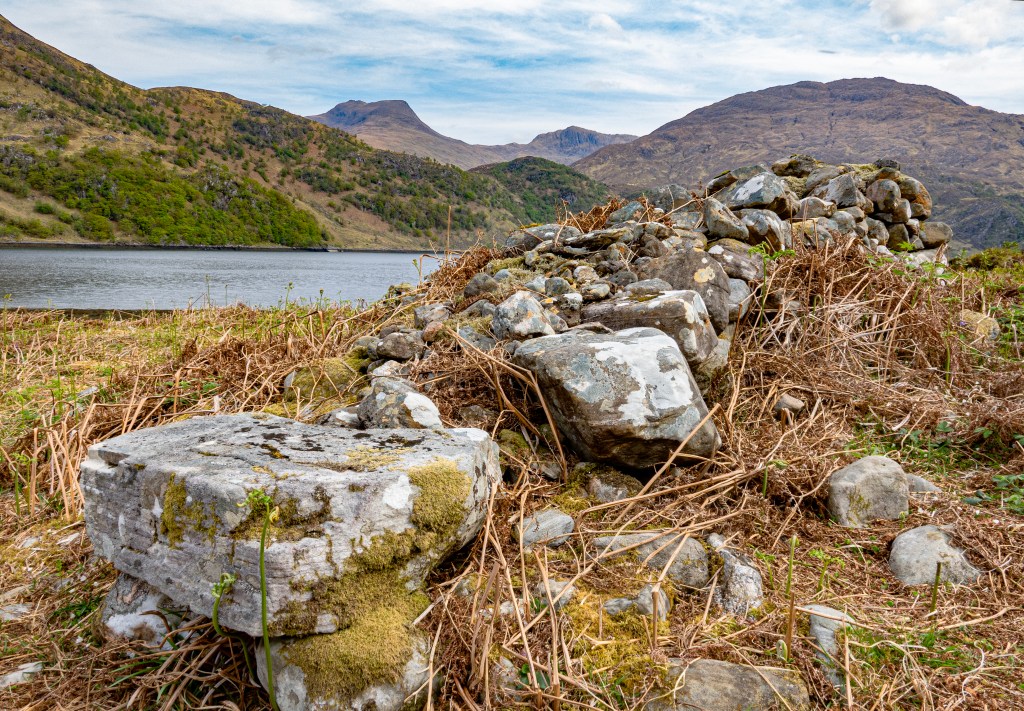
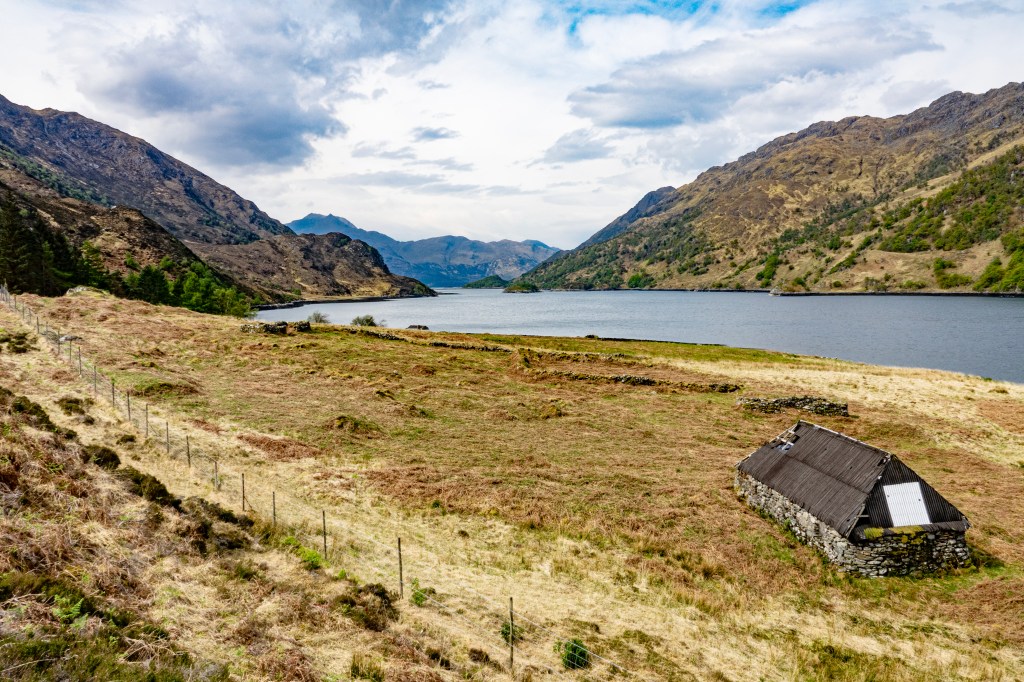
Several ups and downs later, it’s pretty easy to tell I’ve reached Skiary. The flat ground beside the loch is much more expansive than anything I’ve seen here so far. And though the moorland is staging a takeover bid, the grass is definitely darker, richer here, thanks to the animals that once grazed on it. A number of stone walls marking enclosures and a boundary wall still stand a foot or so above ground. There’s an old barn too, low-walled and with a tin roof.
In 1748, the tenant here was Alexander McDonell, who’d been there since 1739 when he leased the farm from Coll’s father Archibald, who lived at Camusdounan on the other, western side of Barrisdale Bay. In 1755, Alexander put his own age at roughly fifty. He was married and oversaw a household of nine, including his wife, presumably a few children, and a number of employees.[ii]
But what delighted the Commissioners for the Forfeited Estates with Skiary was some timber worth the name. Or at least there should have been. In the previous century, as well as the usual complaints about the area being ‘environed with black mountayns and uglie rugged steep rocks,’ a surveyor noted that the banks of Loch Hourn contained ‘plentie of wood on both syds.’ But the 1755 surveyor noted that the pinewood ‘for sometime has been wholly destroyed by vessels fishing for herring in Lochurn.’ On the upside, ‘There is still an appearance of a stool of young fir which by proper care may in time be valuable.’[iii]
But it took a while for anything more than finger-pointing until, in 1767, the factor, Henry Butter, took action, setting out a general plan for improvement across the estate. Alexander McDonell, now had to ‘allow all the ground without (outside) the cornfields to be taken off the firr (pine) wood upon deduction of a third part of his rent from the burn of Skiarie to the marches of Caolisbeg (to the west), which reduced his farm to the present arable grounds.’ I imagine it’s his fields I’m looking at now, amounting to seven and a half acres dug out of much better soil than at Sourlies.
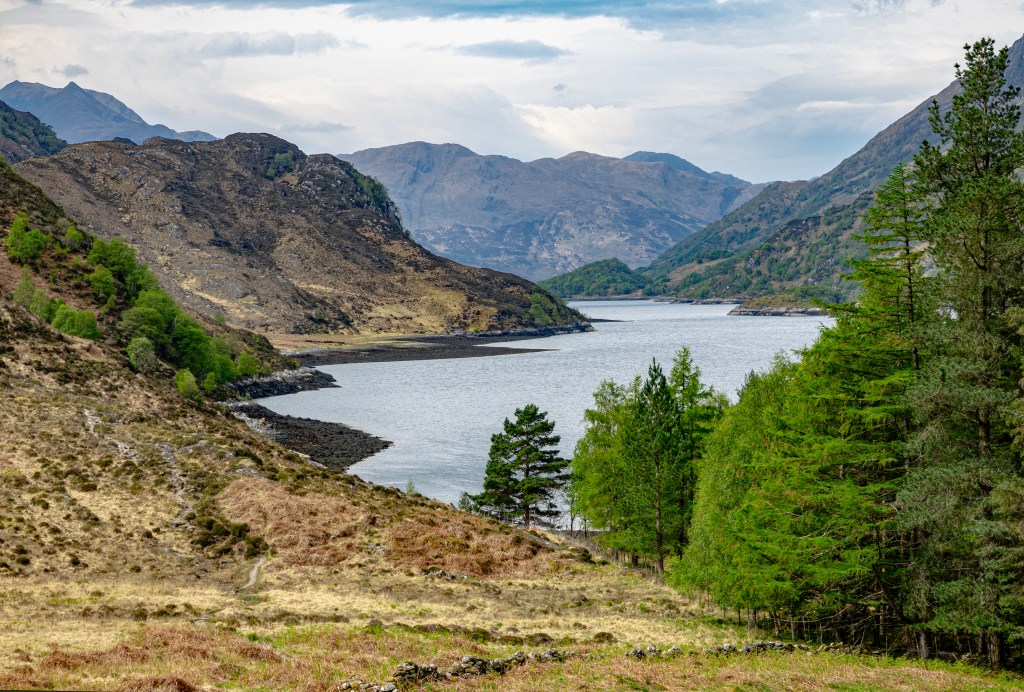
He was also told to apply modern agricultural practices, which meant keeping his arable land ‘in tillage by rotation, this third he divides in four parts, two parts of which under barley and pease and two parts under oats, the pease or other green crops or the barley by turns betwixt each oat cropt so that no two cropts of oats will be successive, this ground he is to delve with the spade and manure it with sea wreck, and to lay down the last cropt with grass seeds among the grain. The potatoes he is to plant in uncultivated ground in order to increase the arable and hay ground.’
But he still had grazing animals, which were to be let loose on the grass grounds that stretched from the Skiary burn to the border with Kinloch Hourn and up onto the hill behind the farm, where there was a small shieling. Alexander was to have a soum of thirteen cows and sheep, as well as one mare, which was less than half what was allowed at Sourlies. The farm buildings were much improved, too, comprising ‘a dwelling house, byre and kiln of stone work and a kaill yeard (kailyard) and a walled barn which are houses sufficient for that farm.’ I wonder if it’s the same barn I can see below me.
Caolasbeg, on the other hand, was to be ‘thrown waste as the firr (pine) wood grows along the whole farm.’ A wood keeper had already been appointed, and he was ‘to be allowed the arable grounds with the grassings [grazing] of Corycharlis [Coire Chaolais, which sits high above the loch some way back towards Barrisdale] free of rent for his trouble, and to be allowed five soums of cattle. Ronald, Alexander McDonell’s son, ‘undertakes the preservation of the grounds from the march of Barisdale to the burn of Skiarie over which grounds the young firr woods are growing and to preserve the woods from cattle or being otherways destroyed.’[iv]
Five years later, around 1772, young Ronald, along with his mother, had taken over Skiary, presumably after his father’s death. He was allowed sixteen cattle – a couple more than his father – as well as a few sheep. But Ronald was explicitly banned from keeping any goats, in the interests of tree preservation.
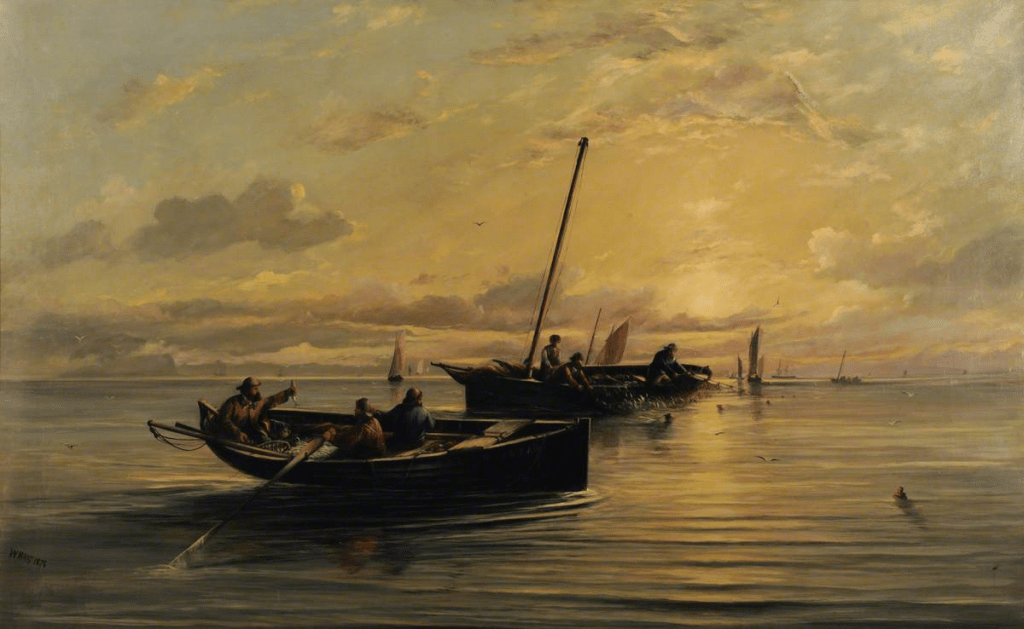
However, the biggest problem the inhabitants of Skiary faced came from the careless folk still sweeping into the loch each year in pursuit of the herring. The 1772 surveyor seems to have scarcely been able to believe his eyes. ‘This farm suffers much from the encroachments of the herring fishers who cure and salt their fish on the verges of the grasslands, walk over their fields in bodies and by that means render the grass unfit to be eat by their cattle. The vessels ride at anchor immediately by the houses, which oblidges the tenants to be continually on the watch in order to prevent their irregularities.’ That’s certainly one word for it. Given that his farm ‘is advantageously situated with regard to the herring fishing,’ Ronald had a boat himself, selling some of his catch to the Bounty Men, but keeping the rest to feed his family.
I’m not sure, given how many of the bussmen there were and how few those living at Skiary, that there was much Ronald could do about them. These problematic strangers were certainly here to stay, even if only for part of the year. As for the woods, needed for the insatiable demands of the royal navy, their care had already passed from Ronald to none other than Lieutenant Archibald McDonell, who ‘undoubtedly is the fittest person in that country for this purpose. And for regulating the numberless disputes among the herring fishers.’[v] Archibald clearly liked a challenge.
And he liked things done properly. In 1773, he wrote to the Commissioners of the Annexed Estates as tacksman of Carnach to ‘humbly sheweth that the proper regulating the herring fishing is a point of general concern to Scotland.’ Though an Admiral Depute and his substitute had been appointed to superintend the fishing throughout much of the west coast and on up to Orkney, the middle section, ‘which comprehends Skye, Lochurn [Loch Hourn] and Lochnevis and other lochs on that coast where of late years there has been the greatest herring fishing’ was situated too far away from either gentlemen to be properly policed, ‘by which means the greatest irregularities are committed by the bush [buss] fishers, and the tenants of the forfeited estate of Barisdale and Kinlochmoidart and others on that coast are almost entirely cut off from the benefit of fishing which for many years past has been the great means of their support.’
He’d done his best, but without proper authority he claimed that really wasn’t much. And so he ‘would most humbly offer his services to the honourable commissioners for superintending this district for such praemium or allowance as to them shall appear reasonable on getting a proper commission by which he would be inabled not only to do justice to the inhabitants but also keep order and regularly amongst the herring fishers.’ Yeah, we saw him being the best man for the job coming a mile off.
Henry Butter, the factor, agreed with both the problem and the solution and so Archibald McDonell was duly appointed ‘deputy justiciary bailie from Garloch to the North point of Mull including the isle of Skye.’ He proved diligent, but expensive, forced to remind his employers that you get what you pay for.[vi]
It’s hard not to find Archibald officious. In 1774, John Clerk, secretary of the Fisheries on the West Coast, wrote that ‘I observe Lieut McDonnell has fined some of the people for fishing on the sabbath day – I believe what he has done may be proper, tho’ by a late law I see liberty is granted to fishers to set their nets and do every other part of the work, what place or at what time they please.’ Still, ‘… this in general has been the most successful herring fishing ever remembered on the coast of Scotland.’
But in 1777, Archibald was assailed not by irate fishermen, but by his own health. Mr Clerk related that in September of that year the Deputy Justiciar Baillie ‘was attacked at Castle Moyle [near Kyleakin on Skye] with a violent rheumatic disorder and threatened with a dropsy ….’ He was no better by the following fishing season, so that ‘he didn’t attend more constantly,’ which must have frustrated Archibald no end.[vii]
And it wasn’t just his health he had to worry about. Despite the lack of repayment of Coll McDonnell’s vast loans, Glengarry was restored to the wadset lands in 1784.[viii] By then, Archibald was a shadow of his former self. I do feel sorry for him, though I can’t say I like him anywhere near as much as Glenaladale, nor find him as fascinating (from a safe distance) as his father. John Knox, the fisheries man, met him in 1786 …
‘… at Barrisdale, a pleasant little bay on the south side of the loch. This gentleman had been in the last rebellion, was taken prisoner, and confined nine years in the castle of Edinburgh, from which he was relieved through the intercession of friends. He lives in silent retirement, upon a slender income, and seems by his appearance, conversation, and deportment, to have merited a better fate. He is about six feet high, proportionably made, and was reckoned one of the handsomest men of the age. He is still a prisoner, in a more enlarged sense, and has no society, excepting his own family, and that of Mr Macleod of Arnisdale. Living on opposite sides of the loch, their communications are not frequent.’
Archibald died soon after, aged sixty. His had been an extraordinary life, thanks to these extraordinary times when change had become normal, whether or not it was welcome. He had certainly been forced to adapt, and quickly, to the very different world forced upon the highlands in the aftermath of the rebellion. The young man who threatened Mungo Campbell is almost unrecognisable in the zealous bureaucrat he became, though I do wonder if they’re two sides of the same coin, rooted in a self-belief passed directly from father to son.
He certainly proved able, just like his father, to take advantage of opportunities that came his way, though now it was not just highland grandees who dangled jobs and pensions in front of those with the ambition and nous to make a go of them, but the British state that Coll and Archibald had fought against so violently only a few years before. The wind had blown long and hard through Knoydart, as elsewhere in the highlands, and few didn’t feel its effects. In the end, the Mcdonells of Barrisdale managed to climb out of the hole they’d fallen into by supporting the bonnie prince, though they still lost much.
But while most of their tenants seem to have survived the war and the brutal ransacking afterwards, they were now being buffeted by ever more blustery winds of change. The race to ‘improve’ was on, with landowners and the government determined to make the land more profitable. And that soon meant sheep, which in turn meant almost no people. And no people is so far exactly what I’ve seen. But I cannot be too far from the metropolis of Kinlochhourn.
[i] E741/25/2(2)
[ii] E741/1/1; E741/20/1(1); E729/3/6
[iii] Macfarlane’s Geographical Collections, vol. ii, 549;E729/1
[iv] E741/43
[v] GD50/2/1; E741/45/1
[vi] E728/14
[vii] E727/19
[viii] E741/11/1; E741/11/2; E741/11/3; SC29/10/868/C. However, in 1790 the courts awarded the Mcdonells of Barrisdale £93,500 (£900 then) as compensation. By then, both Archibald Mcdonell of Barrisdale and Duncan Mcdonell of Glengarry were both dead [https://www.electricscotland.com/webclans/m/macdonn3.html]


Leave a Reply