

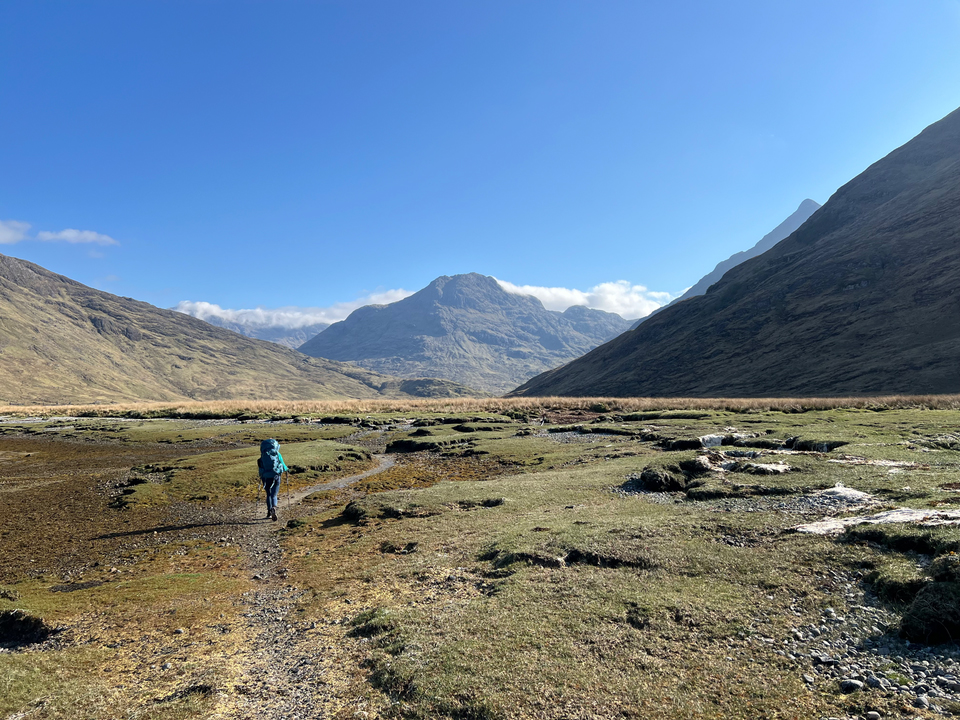
I come alongside Sarah, looking forward to getting to know her. Someone has already mentioned she’s Canadian, which saves me from making the grievous error of presuming she’s American. But I find out she lives in Germany now because of her job. We chat a little and I feel entirely carefree, the spectre of Knoydart’s Rough Bounds dissipating like the clouds. I find her thoughtful and effortlessly impressive.
She stops, eyeing me carefully. ‘Would you mind if I walked by myself? I want to keep my boots dry. And then I can stop and take pictures when I like.’
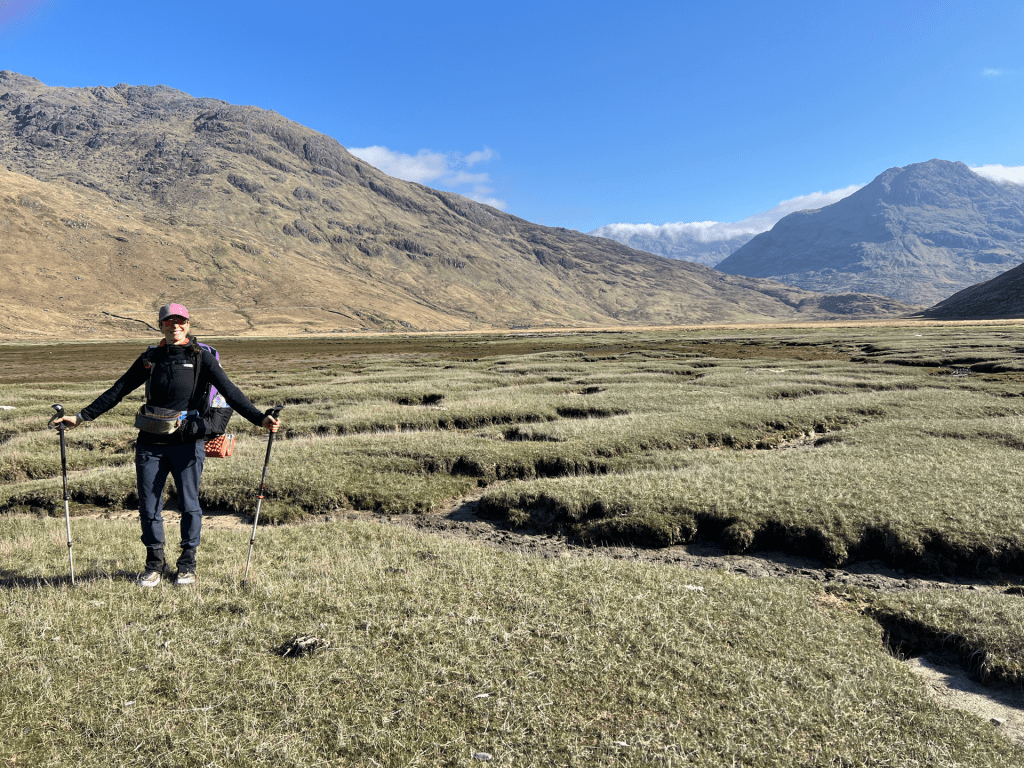
I feel the smile crack onto my face. ‘Of course!’ It’s an utterly reasonable request. I’m almost certainly going faster than she is, and why shouldn’t she enjoy the day on her own terms? But more importantly, why, oh why, do I feel the need to use someone else as a safety blanket? I wanted to do this precisely in order to prove I’m capable of negotiating the trail by myself. And conditions could scarcely be more perfect.
And yet, I’m shaken, though I very much hope Sarah hasn’t noticed. I keep smiling, wish her a good day and that I’ll see her in Barrisdale. Then I turn away, heart in my mouth. Don’t be silly. You’ll be fine.
Still, there’s nothing like putting one foot in front of the other to steady the nerves. And I need to pay attention. For all the lack of rain, it’s still squelchy underfoot. I can see the footbridge over the River Carnach in the distance, but the ground between me and it is maze-like in its undulations, hidden pockets of sand and gravel between the soft mounds of grass. But I reach the Carnach soon enough. It’s a broad river with more than enough water in it to fill my bottle, a pair of sandpipers peep, peeping their way up and down the river, gliding easily on scimitar wings.
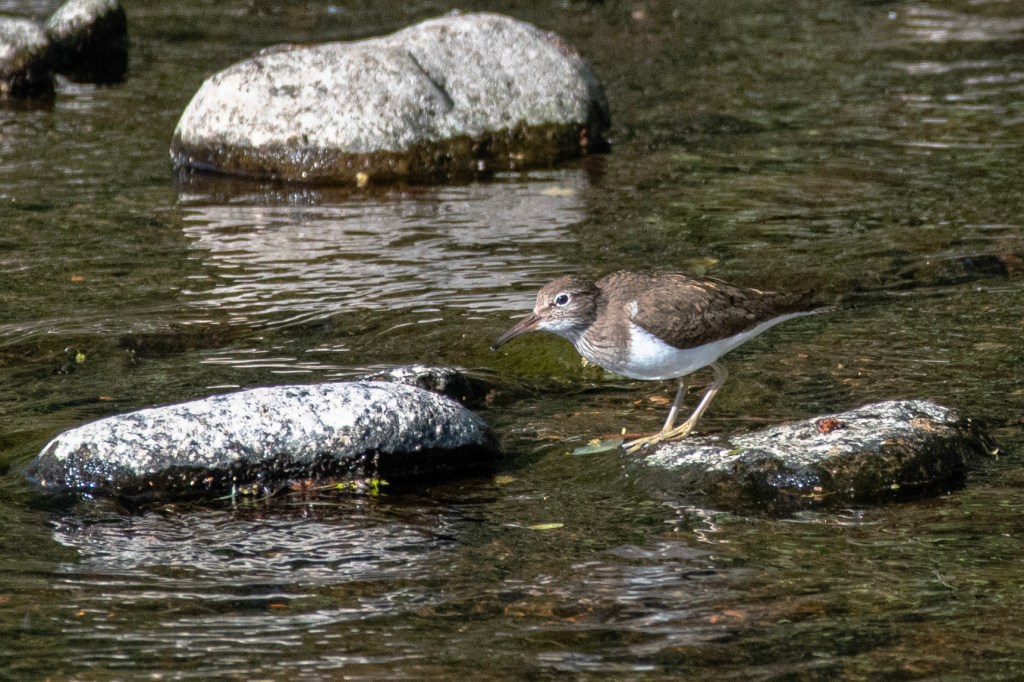
I take off my pack, my shoulder pads bouncing down the bank. I follow them, drinking my fill before letting the water glug into my bottle. I could paddle and sunbathe here all day, with the sun throwing shards of silver into the dark waters, but that’s not going to get me to Barrisdale. I do stand for a moment, taking in all this perfect gloriousness. Okay, so I’m probably putting off the moment when I’ll no longer be able to see Sarah’s dark head bobbing along behind me. But if I can’t enjoy this incredible gift, then I’m not sure why I’m here. The sandpipers disdain my presence, speeding off upriver. I recover my shoulder pads and heave on my pack.
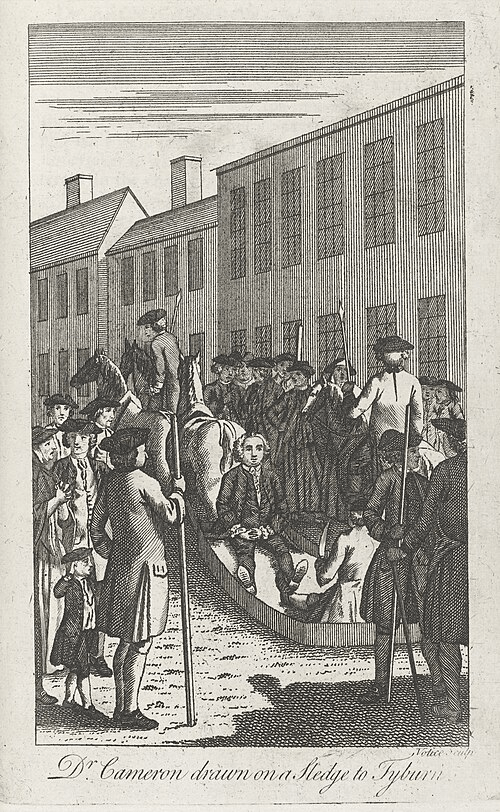
When Archibald McDonell of Barrisdale surrendered for the second time to Ensign Small, camped out in a shieling hut over on the Barrisdale side of Knoydart in 1753, he surely felt a spasm of fear jolt through him, leaving a thrum of anxiety behind in the pit of his stomach. This time he wasn’t with his father, who had a gift for talking his way out of almost any fiasco. Archibald knew he was attainted – that was, after all, why the government men had come to his estate. And he surely also knew that many Jacobites had been executed, including two Macdonalds, the lairds of Kinlochmoidart and Tirindrish. Though most went to the scaffold around 1746, Lochiel’s brother, Dr Archibald Cameron, was executed as late as June 1753, not long before Archibald McDonell was recaptured.
He was, like his father before him, taken to Edinburgh castle where he discovered that the government did indeed want his head. But he put up a spirited defence at his trial in March 1754, pulling at the heartstrings, until – like so much associated with the McDonells of Barrisdale – the whole thing descended into farce. First and foremost, he pleaded his youth, claiming that he was ‘then a boy lately returned from school under the influence of a father who was unluckily engaged in the Rebellion 1745.’
Fair enough. But just in case that didn’t move the stoney hearts of the Lords Justiciary, his lawyers (I presume it was his lawyers) dreamt up a most ingenious ploy to try to get him off on what might be described as a technicality. For they claimed that the Act of Attainder named a man called Archibald McDonald son of Coll McDonald of Barrisdale, whereas the man currently under lock and key was Archibald McDonell of Inverie.
And in order to underline the gravity of such a misnaming, it was stated, presumably with a straight face, that ‘in the northwest Highlands of Scotland there are two separate distinct clans the one of which is constantly called McDonald the other McDonell. That by these names they are as much distinguished as they could be by any two distinct names whatever and on account of a rivalship between them they are remarkably carefull to preserve this distinction upon every occasion, that the prisoner and his family belong to the last of these two clans and have been ever known by the name of McDonell and by no other name for numberless generations back.’
Faced with this fascinating foray into highland nomenclature, William Grant of Prestongrange, on behalf of the Lords of Justiciary, very sensibly attempted to cut to the chase, summoning witnesses who could prove that this Archibald was indeed the ‘identicale person’ to the one mentioned in the Act of Attainder. These witnesses ranged from a member of the Edinburgh town guard to a merchant in Maryburgh and Donald Cameron, the younger, of Clunes, these last two likely to have been well acquainted with Archibald long before his involuntary trip to the capital. Unfortunately nine of them absconded. A fresh set of witnesses were summoned, including Ensign James Small, who may have had better things to do than leave his garrison in the Highlands. The Lords Justiciary tried again with a little more success, though Prestongrange had ‘too good ground to suspect that some others of the witnesses may also withdraw themselves’.
But the government lawyers were not going to let such a ridiculous ploy foil them, perhaps imagining news of it galloping back to the highlands and a veritable army of seannachies marching on the courts to insist that their clients were not the men the government lawyers claimed them to be and that they could recite genealogies going back a thousand years to prove it. This time the Lords Justiciary dragooned respectable Edinburgh men into standing as caution for yet another set of witnesses under the substantial penalty of nearly £5000 [500 merks then] if the latter didn’t turn up and stay turned up.
In the end, it was Archibald himself who decided his cause would be better served by sparing the Crown all this annoyance and expense. On 22 March – nearly three weeks after his trial had begun – he clarified his position, admitting that, though his father Coll ‘resided at Inverie which lands he has in proper wadset from Glengary’, his grandfather – the first Archibald – was Glengarry’s tenant in the farm of Barrisdale, which led to Coll being referred to as the younger of Barrisdale. The game was up and so ‘I humbly submit to the court if or not this brings me within the Description of the said act.’ Archibald was throwing himself on the government’s mercy, finally casting off the ebullient, autocratic ways of his father and his youthful self.
He was found guilty and sentenced to be hanged, drawn and quartered at the Grassmarket beneath Edinburgh castle on 22 May 1754. But their Lordships perhaps felt that Archibald had indeed been led astray by the irresistible Coll, or at least that there had been enough blood-letting, postponing the execution to allow him to appeal to the king, George II, for a pardon.[i] And get one he did, though he spent the next eight years in prison, finally earning his freedom in 1762.
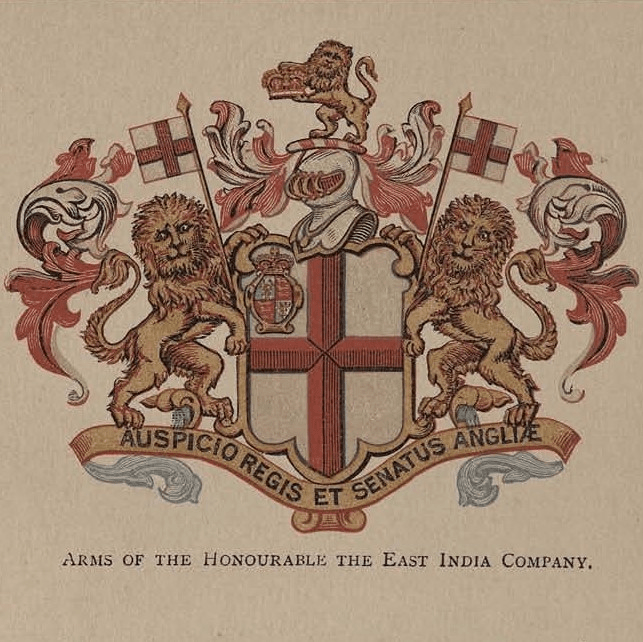
https://archive.org/details/dli.venugopal.747/
A few years later, he embarked upon a brief career in the British Army – which welcomed many a former Jacobite into its ranks – becoming a Lieutenant in the 105th Regiment of Foot, founded in 1766 by the British East India Company and known originally as the 2nd Madras Europeans. Presumably, then, Archibald went to India to help promote the commercial interests of the British state through military might. But he didn’t last long in uniform, coming home to Knoydart for good around 1769. Two years later, he’d become – oh, the irony! – a tenant of the Commissioners for the Forfeited Estates at no less a place than Carnoch, a farm set near the river I’ve just filled my water bottle in.
He was now quite unrecognisable as the bullish young man who’d threatened Mungo Campbell back in 1753. The current factor, Henry Butter, positively gushed about what a model tenant he was, noting that Carnoch and its associated farms and shielings: ‘… is possessed by Lieutenant Archibald McDonald, who by his industry and knowledge in farming is the only gentleman in Knoydart who appears the most spirited in carrying on Improvements especially in draining and bringing in mossy grounds, tho attended with immense labour and expence in making proper divisions of this farm by dykes and ditches in the most advantageous places, this example is begun to be followed by some of the other tenants on the kings lands which will produce a good effect in time.’ Archibald had been lent the money to kickstart all this improving, but he had to pay it back, with interest.
The unimproved state of affairs, according to 18th century scientific knowledge, on the Barrisdale estate (as elsewhere in the north-west highlands), which, according to the commissioners for the Forfeited Estates, had been left pretty much in a state of nature, had long perplexed and frustrated the government. The tenants were probably equally bemused by all these new-fangled ideas – when there were lots of people in each township, looking after cattle and sheep and goats was surely not a problem. Ah, the factor might retort, but don’t you lose quite a few cattle every year falling off the rocky hillsides? That’s £350 a pop, right there, lying in a bloody mess. This way, the beasts can chomp away with nothing to worry about, neatly held within proper enclosures.
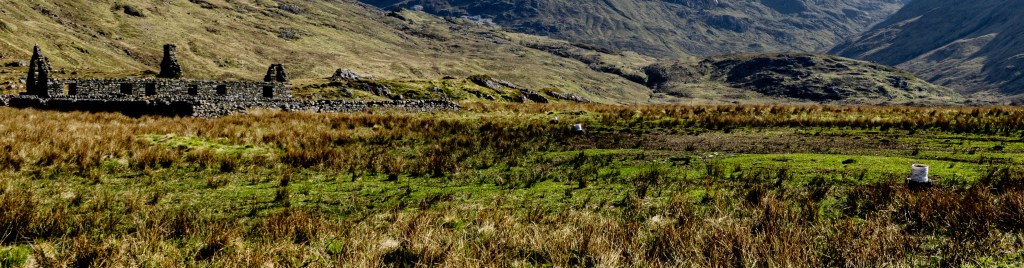
But there was more to be done, partly in taming the land with dykes, but also by draining ‘the flat of Culbain’ that I’ve just picked my way through. That would be quite an exercise, though I’m surprised that the total cost of 300 roods (roughly 300 metres) of ditch and dyke, plus the drainage, was estimated at only around £1500 (£10 then). But then, labour was cheap.
I wonder how Archibald felt, to have to rent farms that he once owned (at least until Glengarry paid off the wadset). He now had a written lease, something he’d never thought to give his tenants, for he – and his father, mother and grandfather – had not thought it necessary when everything was agreed orally. At least he need not feel insecure, given that his tenancy was to last for forty-one years and could be passed on to his son, which was just as well, given that Archibald was now in his fifties.
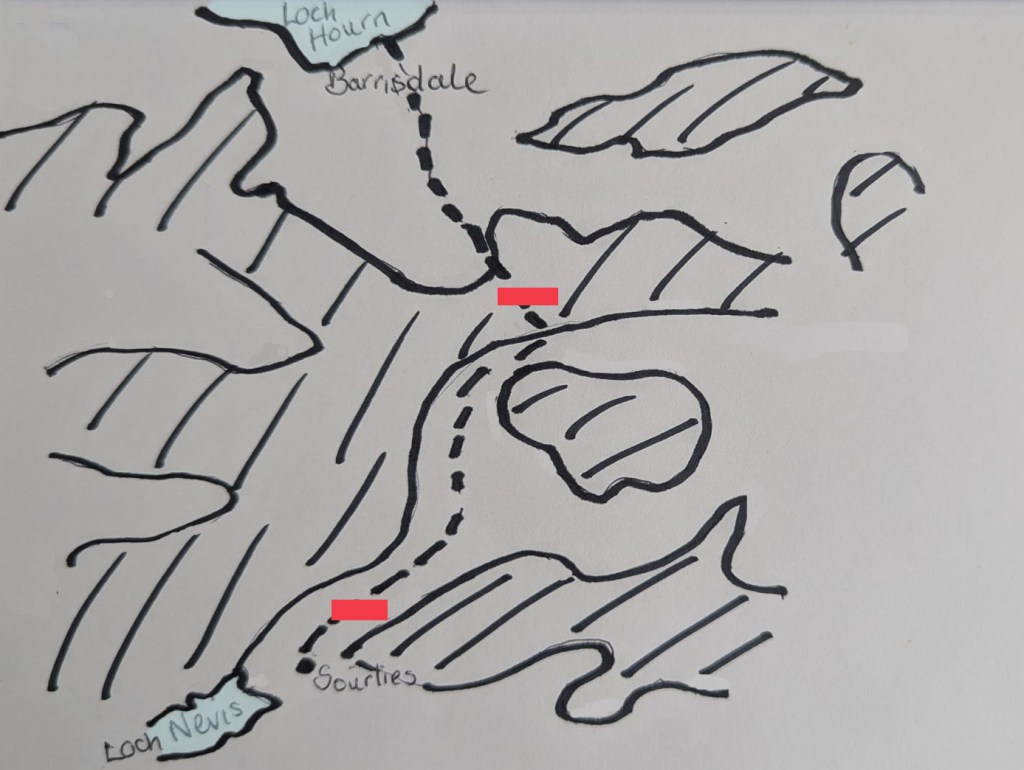
Carnoch was a sizeable holding, comprising ‘all and haill the lands of Culcharnick with the pendicle of Culbain, all and haill the lands of Carnochroy and the lands of Gorton lying contiguous at the head of Loch Nevis with the shealings of Doricharmick and Leckchorie being part of the annexed estate of Barrisdale.’[ii] These were the names of places he would have known since he was a boy, their complex delineation on the ground evolving over generations to meet human needs and laid down probably hundreds of years before. Carnach itself may come from the Gaelic for corner, and it does feel as if we’re tucked away here, round the headland from Sourlies, held tight within a dramatic amphitheatre. It’s what lurks round this corner, when I plunge deep into Knoydart, that I can’t help but wonder about.
But I wonder about Archibald too. Did he think himself a victim of circumstance, rueing the day his father heeded the prince’s call? It’s impossible to tell. But his actions in the later decades of his life suggest he was trying to make the best of the new world that had been thrust upon him. Coll had gambled and lost. But it was his son who seems to have understood best the price that had to be paid by those who survived.
I launch myself on my journey along the north-western bank of the River Carnach, passing the last standing incarnation of the many homes that were once here, the farmstead and enclosures of Carnoch. The farmhouse was a substantial building, presumably the home of a nineteenth-century sheep farmer, like Finiskaig back round the corner, rather than a shepherd’s cottage like Sourlies. I wonder how the three families remaining here a century after Archibald began to rent Carnach got on. No doubt they had to, given that they were the only ones for miles around. And they couldn’t even escape each other in death. There’s a tiny graveyard, still in use in 1873, on a ‘dry island’ (one with a causeway at low tide) a little to the west of Sourlies, where the River Carnach joins Loch Nevis. But who actually lies there – some of the Gillieses perhaps, or Elizabeth Mackenzie, the Sourlies shepherd’s wife – no-one knows.[iii]
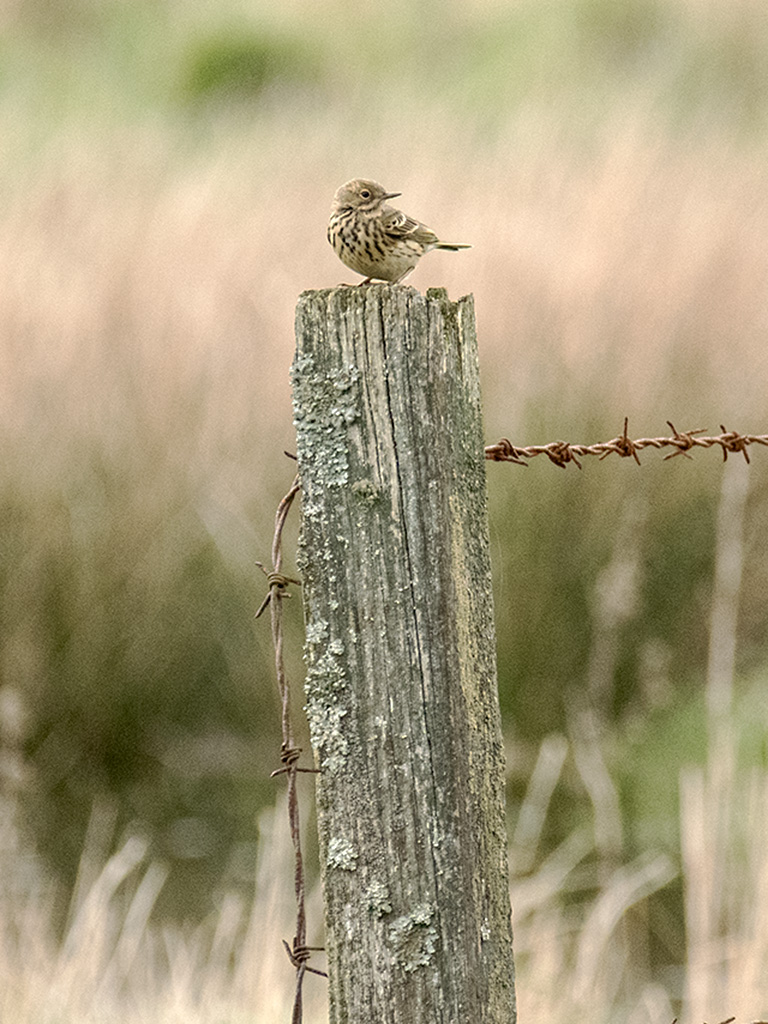
I’m feeling much better, no doubt thanks to a good night’s sleep and having passed through the Day Two Blues. Though it’s not so far in terms of miles, I’ll still have to climb up to 700 metres (about 2300 feet) to get up and over to Barrisdale. The cuckoos are hard at it again, along with the meadow pipits. And as I’m making my way down to cross a little burn, I notice a lizard perched on some juniper leaves, a bright band of sunshine painted across him. I haven’t seen one here in Scotland since I was a teenager, so I bend over to watch him for a moment, keeping far enough away that I don’t disturb him.
And yet there are always many more of them hidden away from our prying eyes or destructive feet. Sadly, we know this because, only a few weeks ago, a wildfire broke out in Glen Rosa on the island of Arran. Once it had finally been extinguished after three days, the Arran Ranger Service had the unenviable task of counting the fatalities: 72 slow worms and 25 adders, 14 lizards, 21 frogs and one toad.[iv] The grass that caught fire so easily this year will grow back soon enough, but it will take a while for the reptile population to recover. But seeing this one, I catch hold of the reassuring thought that I’m not alone out here. I march on.
I’m heading due east, parallel but a ridge-breadth to the north of where I walked yesterday but still at sea-level (not 300 metres, as it is in Glen Dessary). The river is still broad, skimming across rocks and stones. But slowly I begin to turn towards the north, passing the remains of shielings on the other side of the river. Those who used to come here in the summer would have enjoyed a day like this, once they’d done what they needed to do, the making of cheese and butter, a bit of fishing, perhaps, and always the keeping of an eye on the beasts.
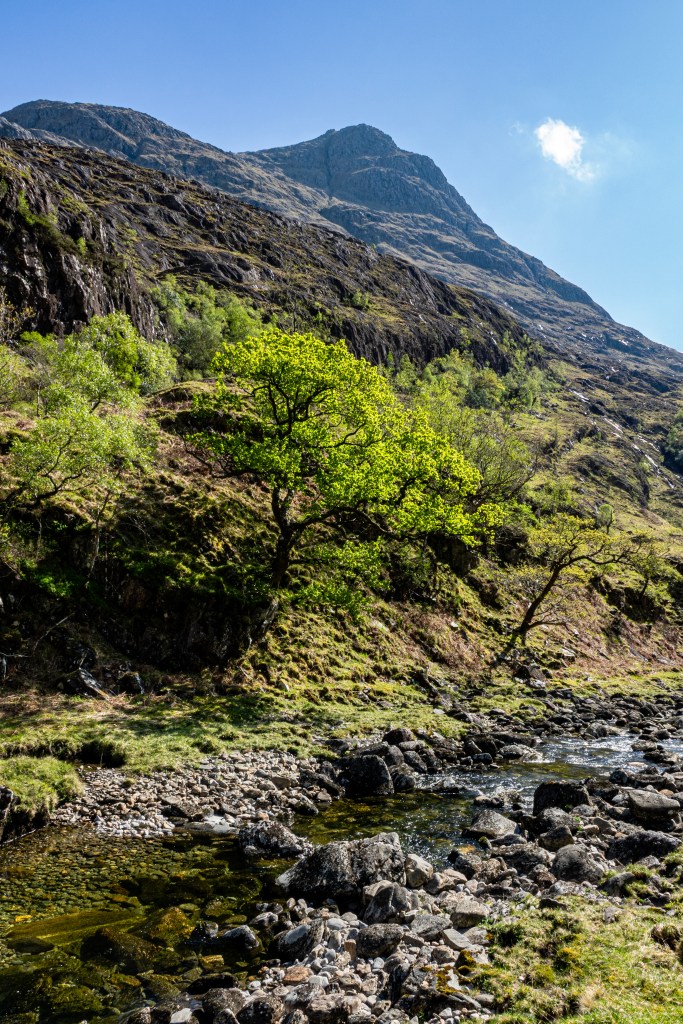
I pass the Allt na Sealga, river of the chase, and wonder who hunted here. Coll, perhaps, and Archibald with him? Maybe Coll didn’t have time, given his hyperactive activities across much of Scotland. Glengarry, surely, in the old days. The river begins to narrow into something of a chasm cleft between the bottom of the skirts of Beinn an Aodainn to the east and Sgurr Sgeithe to the west. And there are trees: twisted, frothing birches emerging triumphantly out of great boulders, a lone oak, luminous green, a lopsided profusion of branch and leaf reaching out towards the west. The trees hug both river banks, but are also creeping up the flanks of Beinn an Aodainn, new growth tackling a steep bank of rock. The mountain’s citadel summit looks down on me, a great dark gash slicing straight down its left side.
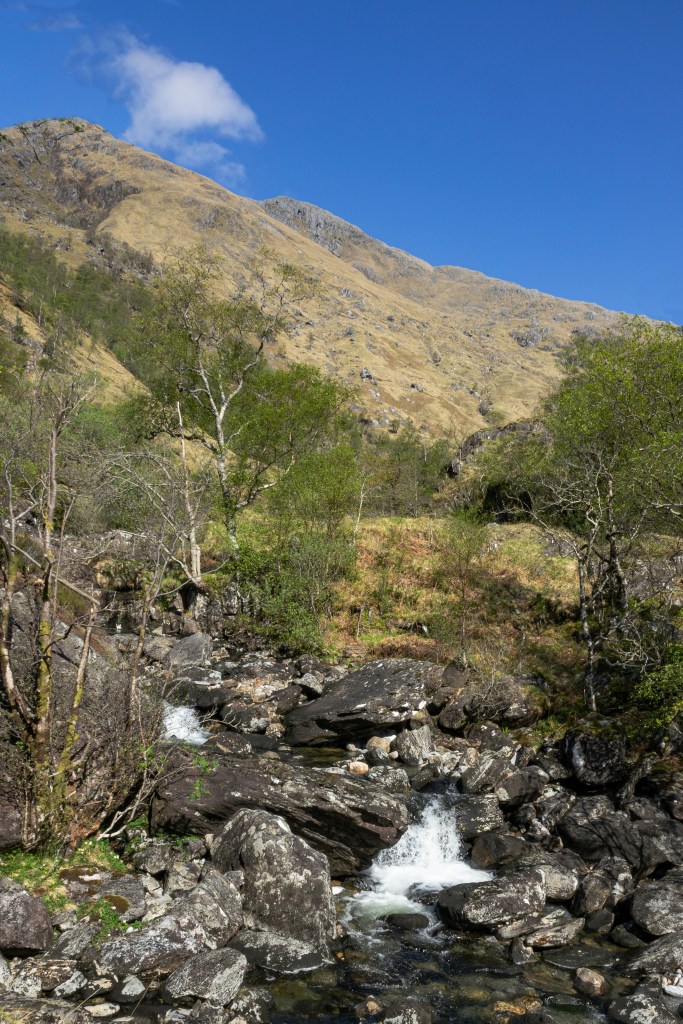
The river still lies flat, the colour of a pale dram of whisky. But I soon start to climb, the water bubbling and frothing pure white as it leaps over stone ramparts before gliding on to the next one. I’m forced up and away from the river, the trees a barrier now, especially their roots, as tough as metal poles. The path is little more than the most obvious way through, much of it crumbling away. The river may not exactly be roaring beneath me, but a false step now and I would certainly tumble straight into it. I wonder about undoing my pack so it rests only on my shoulders, imagining myself landing under the water and struggling to push myself out. My heart is thumping, my poles more of a hindrance than a help. I hang them off my wrists and use my hands to manoeuvre myself over another tree trunk lying sprawled in the way. Climbing up, I test each foothold in case it might suddenly give way. And then I climb down again, hands grasping at whatever feels most solid, using every muscle in my legs to make sure I’m balanced, my pack under control rather than making up its own mind where it goes next.
And suddenly, it’s over. The path becomes surer, moving away from the river and out into the open. There’s more climbing to be done and I stop to drink. I smile, mostly from relief. And I wonder where I’m going now as I scale the side of a short, sharp mound, moving north-east. Soon enough I’m back beside a benign river, smooth and tawny, as if it had never been a roiling cascade only minutes before. To my left, more small, rocky mounds scattered with the odd tree await my ascent, behind them an undulation of hills that at some point I will have to get up and over. But to my right, on the other side of the river, there is a lushness to the steep northern face of Beinn an Aodainn, the birches spindly and effervescent. A great wall of rock plunges straight into the river, like a miniature Pillar of the Kings from The Lord of the Rings.
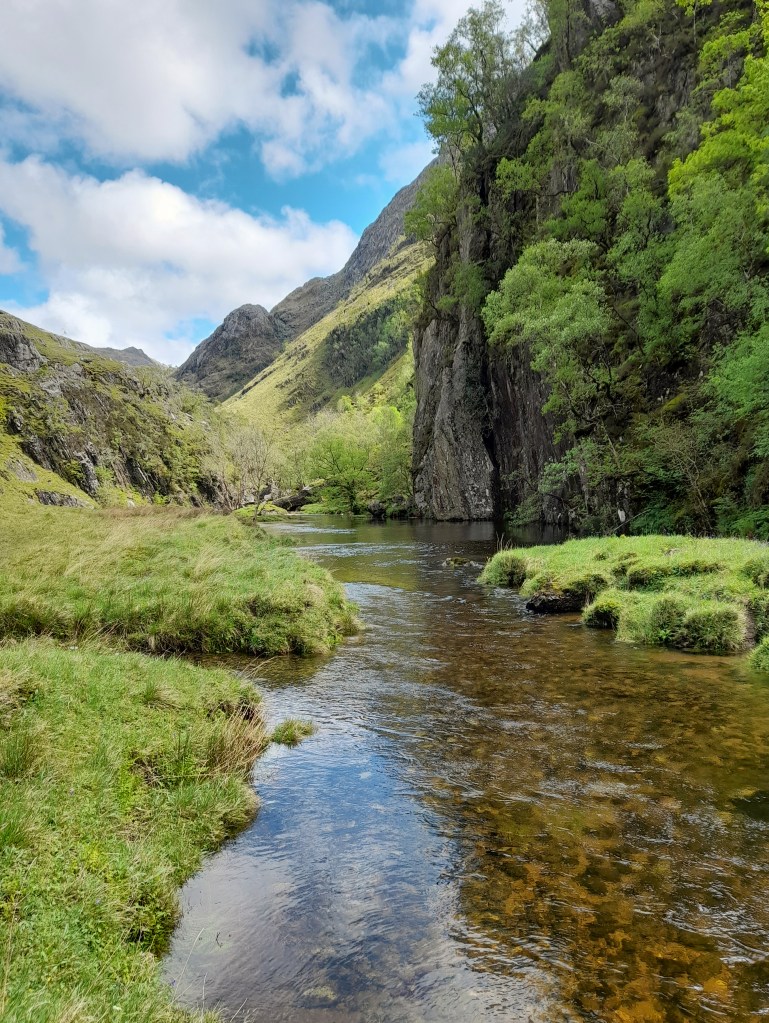
I plough on quite happily, overcoming each mound until I am once more hugging the river, giving no thought as I pass through each parched burn trickling into it from the hillside. I’ve no idea what time it is, nor do I care. I might be hungry, or rather, I should feel hungry, but eating doesn’t cross my mind either. I am, to use the modern phrase, in the zone. I like the trees here, now that they’re not getting in my way. It is really quite beautiful.
I pull up short. The river ahead of me drifts merrily beneath yet another steep cleft, a bulging cliff face clearly making it impossible for me to continue along the bank. I stop, look towards the other side of the rocky hillock. But I can’t see a path up that way, to get round. I am confused, which is as good a reason as any to sit down, eat some lunch, drink some more water and have a really good look at the map. I choose a spot beneath a stunted oak struggling to put leaves on its gnarled old branches.
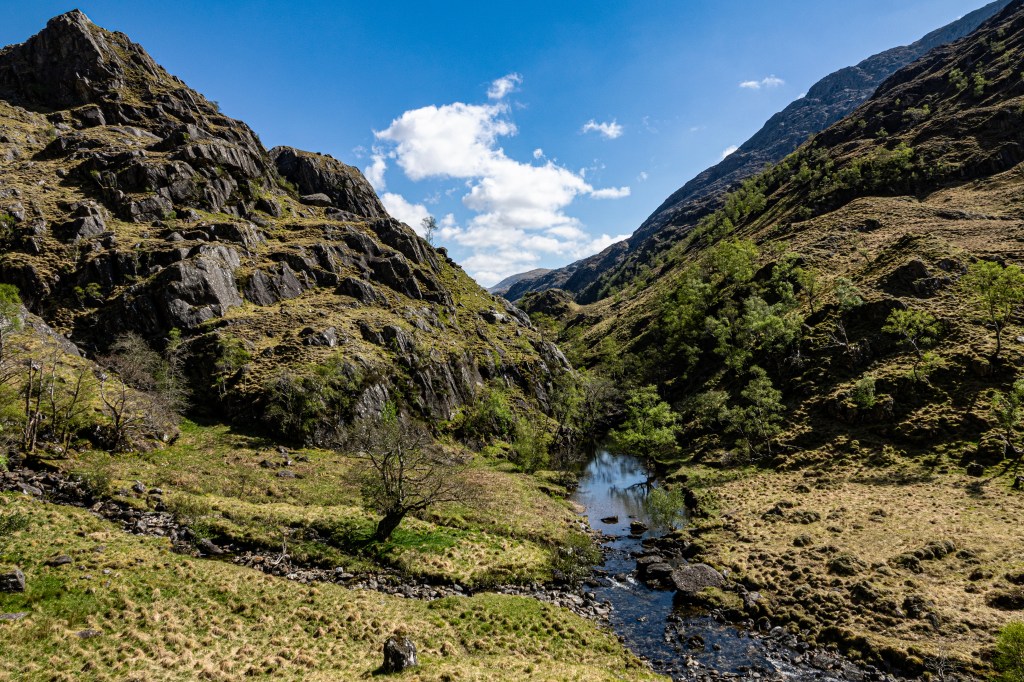
Surely I can’t be here already, the point at which I must climb up towards the bealach between Mam Unndalain and Luinne Bheinn? The map seems to be telling me I am, as I trace my route up and around the tricky wooded corner I’ve not long clambered through into the upper glen. I can see the burns I’ve just crossed, the narrow rocky corridor that the river is about to pass through. But I’m not convinced.
I press the GPS button on my watch. It tells me to get out of the way of buildings and trees. That’s easy for it to say. I walk away from the lee of the hill, towards the river. If it can’t pick up a satellite there, it won’t do it anywhere round here. I wait, glancing up the hillside for any sign that that is where I’m meant to go. After what seems like hours (but is really only a few minutes) the GPS leaps into action. It too tells me I’m at the end of the road so far as the River Carnach is concerned. It’s time to start climbing.
I go back over the last burn and begin to zig-zag my way up the tussocky hillside. But I soon turn round, drawn to look down on where I’ve just been sitting. Now that I’m higher, I can clearly see there’s no way through, great slabs of rock pyramiding up to a sharp point that’s attached to the rest of the hillside. But I still won’t believe I’m in the right place. I climb higher still and turn again to glimpse a long narrow loch nestling at the bottom of row upon row of ridges propping up an endless chain of mountains. The map tells me it’s Loch nam Breac, out of which the River Carnach begins its short journey to the sea. The light falls intensely on this creased, crumpled land, but on my right-hand side the shadows are scored in deep. White clouds stream across the eastern horizon like eager fans on match day, almost catching each other up.
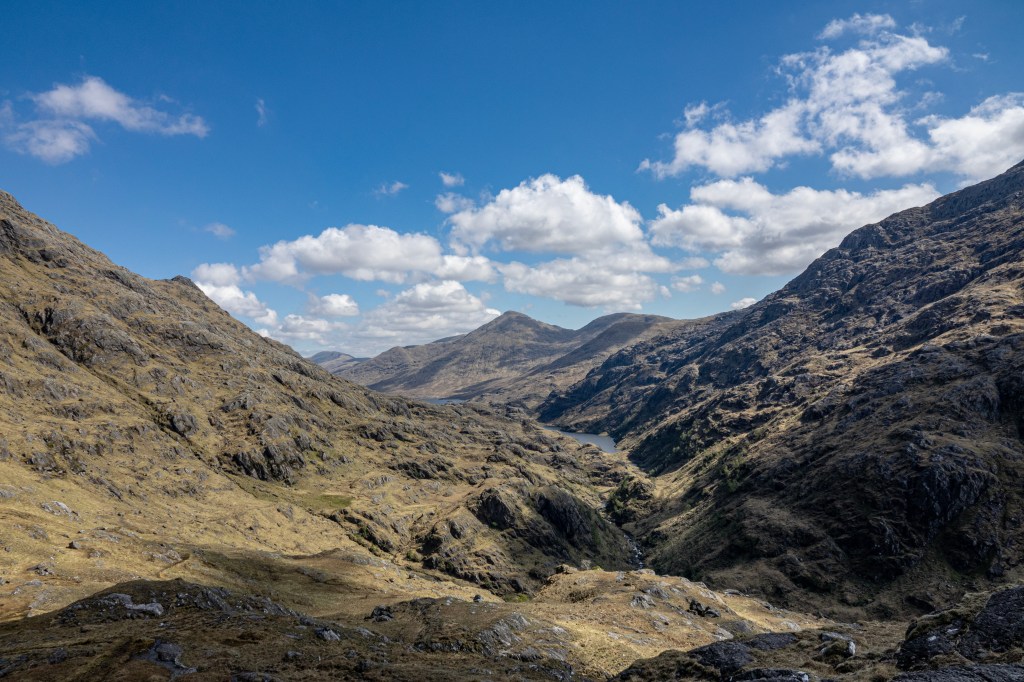
Now I feel I’m among the eagles, each zig-zag bringing height and perspective. I enjoy the gathering vastness, the heady sense of infinity. It soothes my mind, putting me in my place again. I reach a track coming in from the right, just as the map foretold. Now will you believe?
[i] JC27/99; https://www.electricscotland.com/webclans/m/macdonn3.html
[ii] E741/44; E741/45/1
[iii] https://www.trove.scot/place/80188#activities; https://www.findagrave.com/cemetery/2689475/eilean-tioram
[iv] https://news.stv.tv/west-central/arran-wildfire-decimates-reptile-population-with-hundreds-dead
 The Other Side of Wild: Walking through Time and Space on the Cape Wrath Trail
Leave a comment