

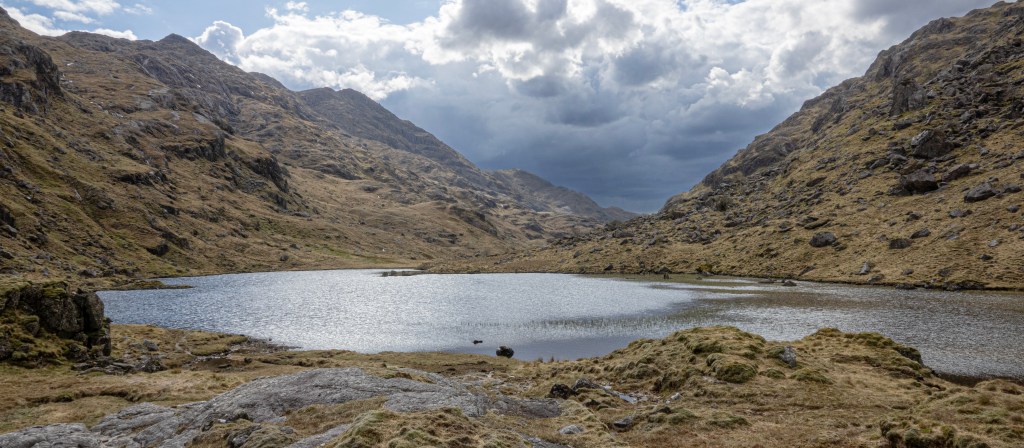
So here I am in the Màm na Cloich’ Airde – the pass of the high rock – in a much better mood than I was an hour or so ago. I flit easily along great flat stepping stones lying like grave slabs in the grass. Lochan a’ Mhaim glints, metallic beneath the clouds, a haze of pale green rushes softening its eastern edge. I am enchanted by what feels like a primeval landscape, imagining a glacier tracing hieroglyphics on the rock beneath as it ground its way past. And now, 10,000 years later, its story is right here in front of me, a constant reminder that, however long ago it was in human terms, it’s no time at all for the land itself.
I love the sticky rock I’m walking across. I love the pinpricks of molten sun dancing across the lochan, picking out the knots and gouges in the stone, lichen-crusted. Now that I must concentrate a little to keep my balance, my eye delighting in whatever it falls upon, I’m no longer tired, my pack and my feet no trouble. I contour round the lochan, a breeze feathering its surface. It’s impossible to imagine that anything else exists but this place and this moment.
And it’s also hard to imagine anyone else here. But that’s a delusion. Given that I’m walking along a drove road, however slender and fragile, the bellowing of cattle would have bounced off every boulder when the herds passed on their way to market in Fort William or at the beginning of their epic journeys to the south of England via the trysts at Crieff or Falkirk. Instead of quiet symmetry, the whole landscape would be alive, shuddering and trembling. The animals were no doubt outraged and alarmed at being forced away from familiar pastures, though I imagine them now wading eagerly into Lochan a’ Mhaim for a welcome drink after their arduous climb up from Loch Nevis.
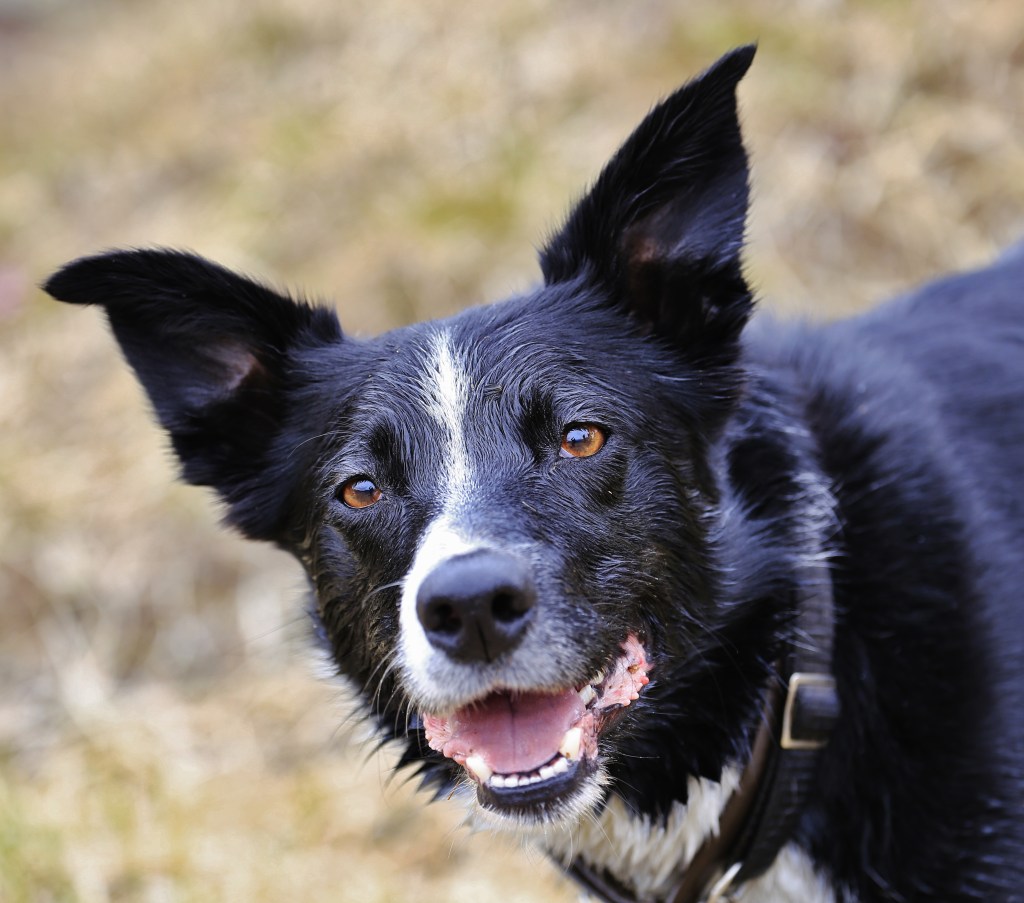
And if I’d been here even a century ago, I might have seen something similar with my own eyes. In 1933, when the writer Paul Seton Gordon and a friend were exactly where I am now, they ‘saw approaching a party of travellers. Two pleasant-faced lads were driving before them a stirk and a young bull; a couple of sagacious and friendly collie dogs completed the party. They were crossing from Loch Nevis to Loch Arkaig on their way to Fort William for the sales, and were moving slowly, for the beasts were ill at ease in their unaccustomed surroundings.’[i] Even then, when my dad was a youth, things still took the time they took and walking was how most people got around, even if the distance to be covered might be more than thirty challenging miles.
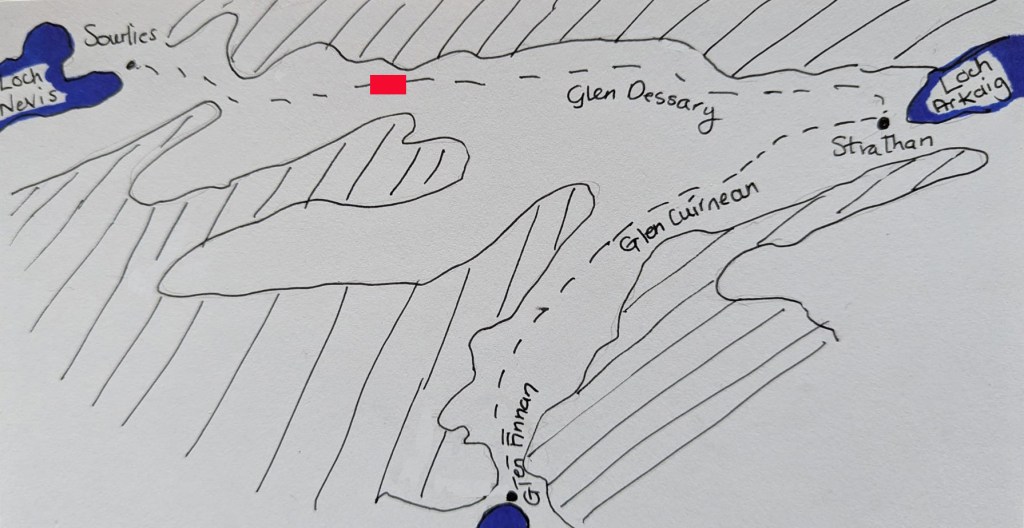
But mere topography wasn’t the only hazard. After the rebellion, the lands of those chiefs who’d joined it were taken into government hands by a general act of attainder passed in 1746.[ii] Mungo Campbell was given the unenviable task of managing the estates of Lochiel, Barrisdale, Kinlochmoidart, Ardsheal, Callart and Keppoch, a jurisdiction that stretched from the western end of Knoydart down to Loch Leven near Glencoe. Sensibly enough, he elected to base himself at Lochiel’s house of Achnacarry (Lochiel himself having fled to France), which was roughly in the middle. Given that Achnacarry lies due east of Glen Dessary, Campbell was likely to use this same drove road to approach the Barrisdale estate in Knoydart, which included the farms at the eastern end of Loch Nevis not too far away from where I am now.
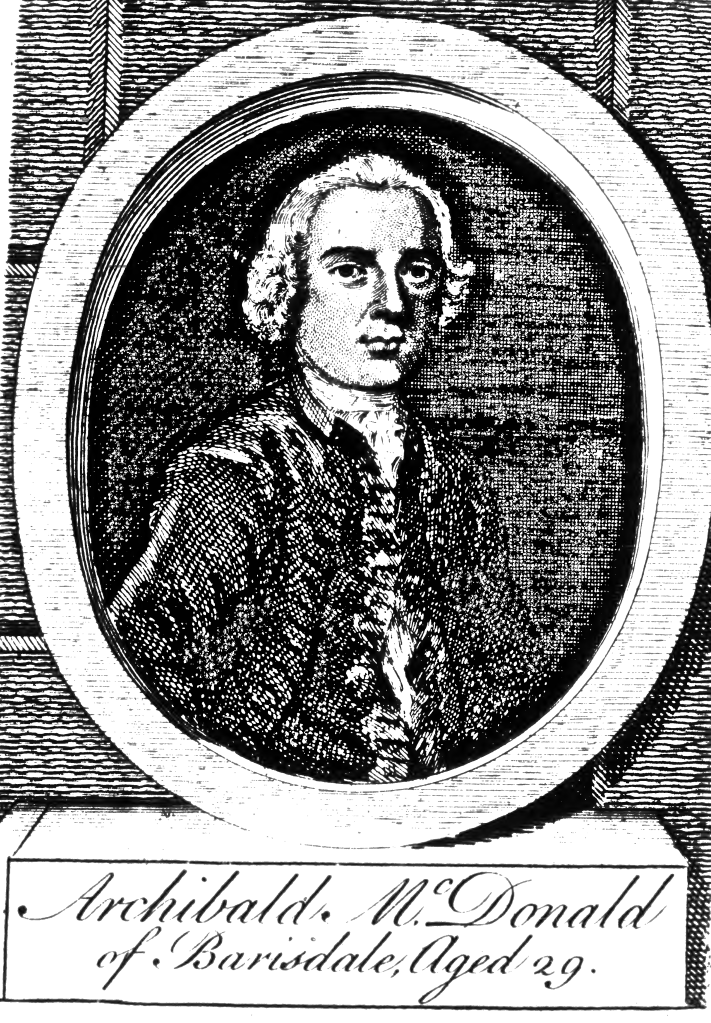
But there was still life in one particular Jacobite yet. Though Mungo Campbell supposedly accounted for the rents of the Barrisdale estate from 1750,[iii] the tenants were still also putting money into the pocket of Archibald McDonell of Barrisdale. The twenty-five year old, currently in exile in France, had just inherited the estate stretching from Loch Nevis in the south over the hills of Knoydart to Loch Hourn in the north from his father, the infamous Coll ‘Ban’ McDonell, who died a prisoner in Edinburgh castle on 1 June 1750. The only trouble was that young Archibald had been forfeited. And so, unsurprisingly, the British government was of the opinion that it, and it alone, had the right to receive rents and manage the estate.
However, though a survey was made of the estate in 1748, the factor didn’t make any attempt to go to Knoydart until 1753, which probably meant the government didn’t see any money from Barrisdale. Meanwhile, the Barrisdale tenants on the Loch Nevis side gave their rents to Archibald’s stepmother, Mary Mackenzie, while the Loch Hourn side was managed by his grandfather, another Archibald, till his death around 1753, and then by his grandmother, Elizabeth Mackenzie. This would have been hard enough for the tenants, given that, as even the government admitted, much of the estate had been laid waste by their troops who had been given carte blanche to wreak revenge on those they viewed as Jacobite scum while they were searching for Prince Charlie.[iv]
Some of this money would have made its way to Archibald in France. This was a fairly common occurence in the aftermath of the rebellion if a Jacobite landowner had managed to escape and needed money to pay for his upkeep abroad (his tenants sometimes even paid two rents, one to the government, one to their chief); that’s why Alan Breck Stewart returns to Scotland in Robert Louis Stevenson’s Kidnapped, as someone had to physically pick up the cash, avoiding government troops and officials. But in 1752 Archibald McDonell returned to his native land, settling back into normal life as if nothing had happened.
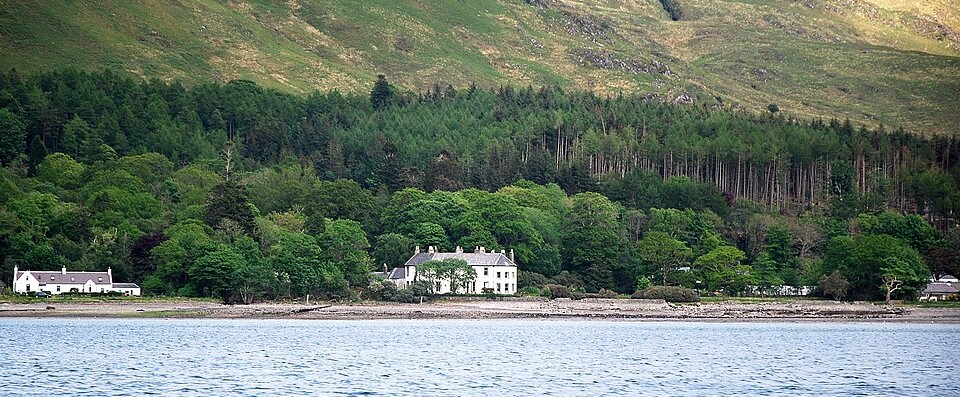
He seems to have settled in with his step-mother, Mary Mackenzie, at Inverie, the main township on the Loch Nevis side of Knoydart where his father had built a splendid house only two years before the rebellion. Archibald was certainly with Mary at Whitsunday 1752 – the traditional time of year when much estate business was done – agreeing leases with his tenants.
But he must have known about his forfeiture. Apart from anything else, his step-mother would have told him that a Forfeited Estates surveyor, David Bruce, had come to Barrisdale to see who paid what rent in 1748. And even though royal officials hadn’t been back since, Archibald was surely living on borrowed time, his return to Knoydart a provocation that the factor, Mungo Campbell, couldn’t ignore for much longer.
In the late spring of 1753, news reached Inverie that Campbell was finally on the move, the showdown set for June. By then, the factor was in Fort William, making ready to travel to Knoydart, though he needed to plan carefully, having been informed that Archibald McDonell ‘had publickly threatened to oppose the deponent by force of arms if he should go to hold courts on said estate or levy the said rents.’ The place that was mentioned as the likely site of an ambush was Màm na Cloich’ Airde, the pass of the high rocks I’m now picking my way through.
The pass of the high rocks was an excellent choice. A map made in 1755 doesn’t mince its words when it came to describing what southern surveyors – used to rolling hills and corn-rich plains – viewed as a hostile, barbaric landscape. Though there was a road – presumably the faint track on which I’m walking – it was ‘cut through rock’ between ‘terrible precipices.’[viii] Mungo’s party would have been sitting ducks, walking or riding single file, McDonell and his men presumably hidden on the rocky hillsides above.
But it says something about the confidence – or stupidity – of young Barrisdale that he should have made his threat so publicly. He had clearly not absorbed the momentousness of the changes that had already taken place during his young life. Here he was, blithely employing the tactics, or at least the threat of them, that might once have seemed perfectly acceptable to a highland landowner whose authority had been challenged. It was certainly what his father would have done. But now, all Archibald had succeeded in doing was drawing attention to himself and the precariousness of his existence on his own lands.
Mungo Campbell was also under pressure, knowing perfectly well that his superiors would brook no excuses if the rents weren’t soon forthcoming, especially if the person currently receiving them was an attainted rebel. So he laid his plans carefully. The problem wasn’t just Barrisdale’s Jacobite former owner; Campbell needed ‘to prepare the proper necessarys for a journey into a country where no provision is to be got,’ buying from Hugh Glass, a vintner in Maryburgh, ‘rum, whisky, mutton, meal, cheese, butter etc to subsist us on the journey’ for the princely sum of £4 19s 6d (c.£1000 today). It was clearly vital that Mungo and his men should approach Knoydart in a state of semi-drunkenness.
At last, in June 1753, the factor and his party, along with six baggage horses, set off for Glenfinnan where another 10 shillings (c.£87) was spent on whisky. They then continued west for twelve miles on ‘extraordinary bad road’ to Lochailort before sailing round to Keppoch in Arisaig where a further 11 shillings 8 pence (c£100) was spent on drink, an amount put into perspective when compared with the 8 shillings (£70) it cost to hire the boat and crew. Four more, presumably smaller, boats then conveyed them the twenty-five miles round the coast of Knoydart to ‘Barrisdale,’ by which they meant Inverie on Loch Nevis.
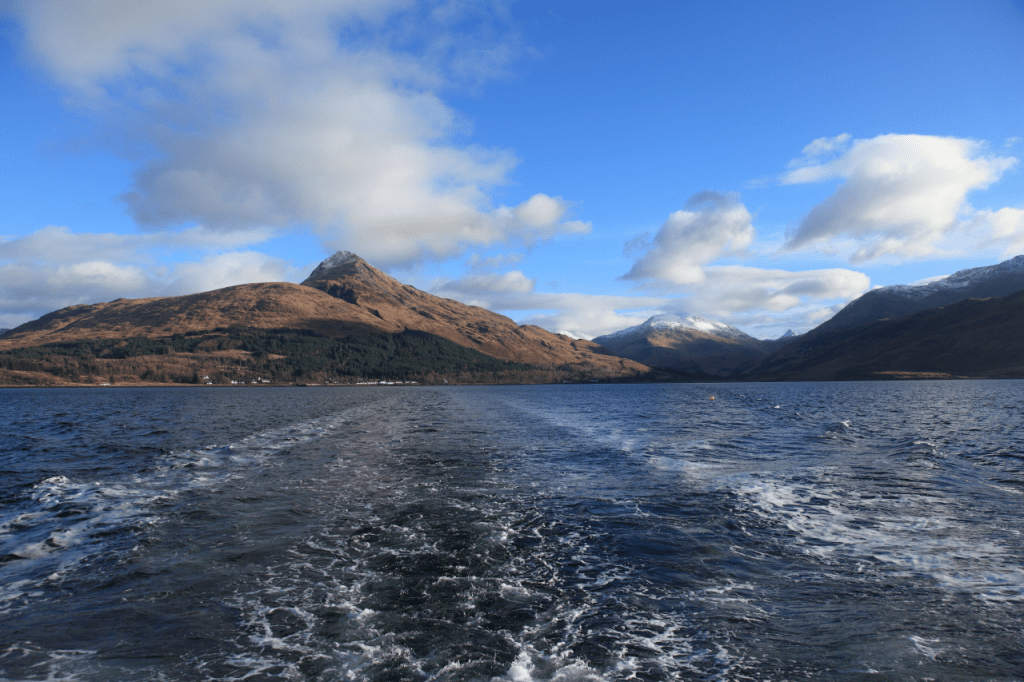
As well as minimising use of the terrible roads, this convoluted journey also had the obvious advantage of avoiding the Màm na Cloich’ Airde. The whole expedition cost over £6500 at current prices, but, with Mungo Campbell firmly installed at Inverie for the time being, the tenants summoned to divulge what rents they paid, and Archibald McDonell once more on the run, it was presumably money well spent. And at least some of that money had been redistributed to locals, albeit mostly in liquid form.[ix]
I’m running out of land, my path turning right to wander over to the other, northern side of the Finiskaig river that feeds Lochan ‘a Mhaim. As I turn left, towards the west again, I’m faced with the Cadha Mor – the great corridor. It’s steep and precipitous, though not dangerous, and my exertions are soon rewarded with a view out over Loch Nevis and – at last – down to Sourlies bothy. Loch Nevis itself is a great slash of steely grey, but I lift my eyes beyond it, enjoying the heady vastness of sky and land and water after being shut up in the Màm na Cloich’ Airde. A long splatter of dark cloud trailing thin ribbons of rain hangs on the horizon well out to sea, a long way from here.
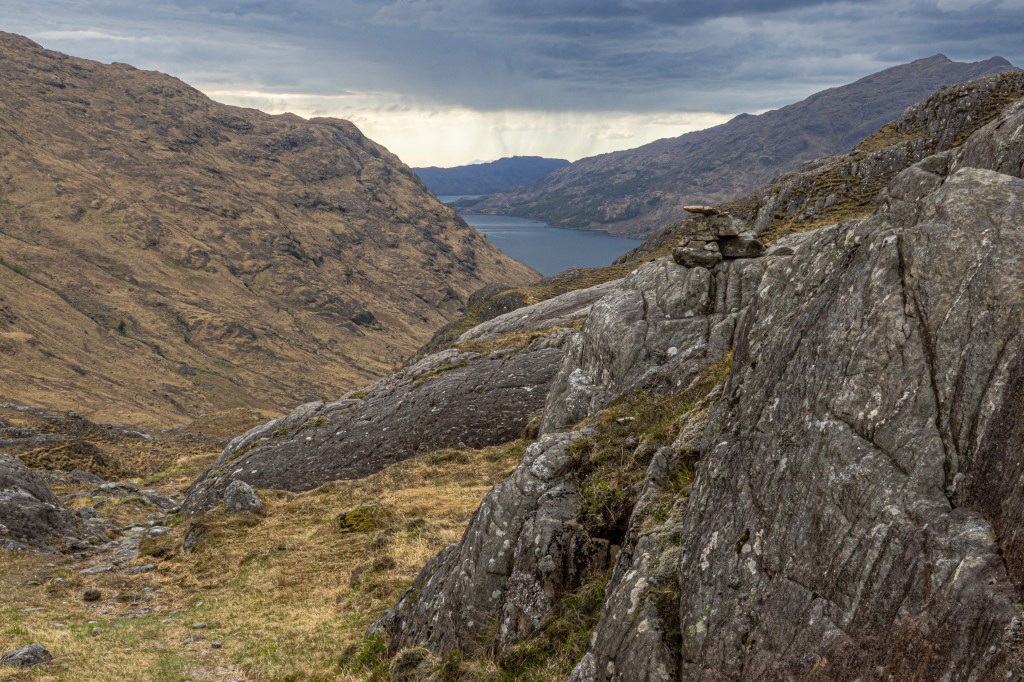
Walking downhill is harder work than the last hour or so of slab surfing, especially with a pack. It’s wise to take it canny, given how easy it would be to give myself a good hard dunt anywhere the length of me if I were to slip and fall on a path that resembles a river of skittish stones. I have no desire to bring my Cape Wrath dreams to an ignominious end on Day Two. And it’s no place to come a-cropper, given how far it is to anything approaching civilisation, forward or back.
I need to pay attention to the route, too, given that the great tumbles of stone and rock strewn across my path make it hard to find the right way. Thankfully I only need to back-track once, and make slow but steady progress down the formidable cliff face. I’m not the only one to find it daunting. William Morison, yet another government surveyor who went through the estate with a fine toothcomb in 1771-2, could scarcely believe his eyes when it came to the drove road heading up from Loch Nevis. ‘This road begins near the Loch and is carried zig zag ways for a great distance over dreadfull and dangerous precipices with the addition of a rapid burn tumbling over the high rocks and is only fordable in one place.’[x]
Now, as I think about the countless generations that have walked up and along what seems such a remote, even desolate path, I feel – what? Bewilderment, perhaps, that what was for centuries up until perhaps only a few years before I was born such a normal part of life should now be so far gone I can’t truly imagine it. It’s not that I’m nostalgic – I should think few would miss having to traipse so far as a matter of course, though I imagine too that there was a lot of fun to be had, especially if parties of young people were those taking the cows to market. I can see in my mind those ‘pleasant-faced lads’ that Seton Gordon encountered, bright-eyed and hopeful, so at ease with their walking and each other and their dogs.
And yet, like their predecessors some two hundred years before, war would soon rock their world. I think of Bert, my dad’s eldest brother, the one for whom the violin was made. He was shot down over Norway and died of hypothermia in the freezing sea off the Vagsøy peninsula on 27 December 1941. The effects of that death on my dad were utterly heartbreaking and formative. He was eighteen, old enough to join up, but deemed unfit because of severe eczema. Whether they said so or not, my grandparents always blamed him for not being the one in the water.
But he also nursed his own entirely self-inflicted guilt for not writing to Bert in time to thank him for the football his brother sent early for Christmas just before he took off for Norway. I could mutter some platitude here about seizing the day, a lesson I’ve certainly taken to heart these last few years, as my fifties began to slip inexorably towards the big 60. It’s why I’m here, surely, on the Cape Wrath Trail. But I know my younger self would just have rolled her eyes, for youth blossoms in the certainty that there is all the time in the world.
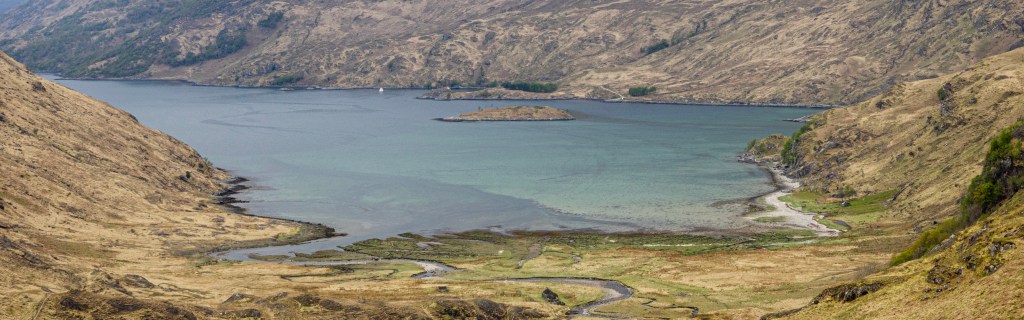
Soon enough I’m zig-zagging, but on a much firmer track than at the top of the cliff face. I feel relief building, though it’s probably best to stifle the thought that I’ll soon be done for the day. Out of nowhere I catch a glimpse of the top of a head of brown hair beneath me, unmoving. I think it’s a man, but as I round either a zig or a zag to come level, I see it’s a young woman, statuesque and rosy, sitting and looking out over the vast sweep of earth and sky and water beneath us. The head turns, smiles. We greet each other. Gaby – a doctor from Norwich – is en route to Sourlies too. She’s following the Cape Wrath trail, but must finish at Inverie tomorrow so as to get the boat back to the railway line.
But right now, Gaby is taking all the time in the world to soak up the view. ‘It’s amazing.’ She says it with a wonder that seems to glow from deep inside her. From my brief acquaintance, I decide that Gaby is one of life’s great appreciators. But I want to get on, and anyway, truly appreciating is best done quietly, on your own. I reach a gorge with a river splashing about in it, shrouded in the dark green of a new-leafed wood. Unlike those who came before, I need not ford it, for there is a bridge, though some of its timbers look decidedly ancient and less than robust. But since I will be crossing it no matter what, I push aside any thoughts of cracking, splintering, falling.
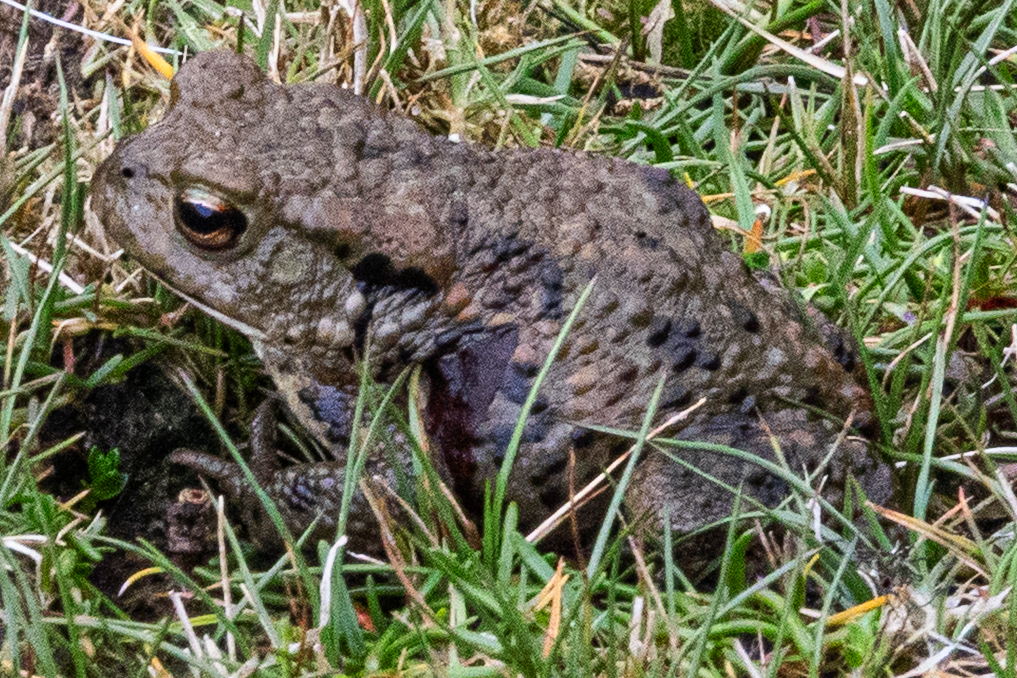
And finally I’m at the bottom, picking my way across grass onto the narrow spit of beach sweeping round the eastern end of the loch. A band of kelp sits between stony sand and salt water, long, copper-coloured hanks twisting together like giant strips of pappardelle pasta. I hopscotch my way from grassy outcrop to grassy outcrop, avoiding the slippery kelp, stopping to investigate a crouching toad. He’s camera shy, moving round out of my way as I’m poised to click, studiously refusing eye contact. But they are very beautiful eyes, gold-rimmed, liquid clear. I leave him alone.
Sourlies sits ahead of me now. Like Corryhully, it’s a neat stone-built structure with a corrugated metal roof and the bulge of a chimneybreast, this time in the right-hand gable wall, nineteenth century at the earliest. A typical Scottish bothy, it provides welcome shelter but little more in terms of creature comforts. Those you have to bring with you. But I’m so glad to see it. This place has been growing in my mind to take on holy grail proportions, at least since I saw the sign telling me I still had four hours of walking to get to it. But, for the record – since I’m clearly desperate to prove I’ve still got it, even at fifty-nine and two-thirds – I made it in three and a half hours.
[i] Seton Gordon, Highways and Byways, p.137
[ii] In the survey of 1755 more than one tenant tells the government officials that they had taken a lease from Archibald McDonell and his mother in person in 1752 [E741/20/1(1)].
[iii] E741/18/2 (4)
[iv] E741/1/2
[v] https://www.clandonald.org.uk/cdm13/cdm13a18.htm
[vi] Bloodletting was common practice in medicine from antiquity, intended to rebalance ‘humours’ [blood and other bodily fluids]
[vii] GD137/3357
[viii] RHP111/1
[ix] E741/18/3 (12); E741/18/3 (4)
[x] GD50/2/1


Leave a Reply