

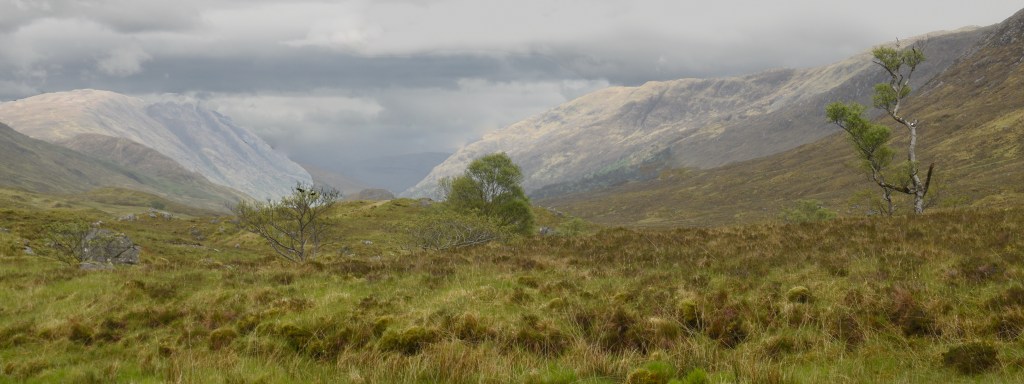
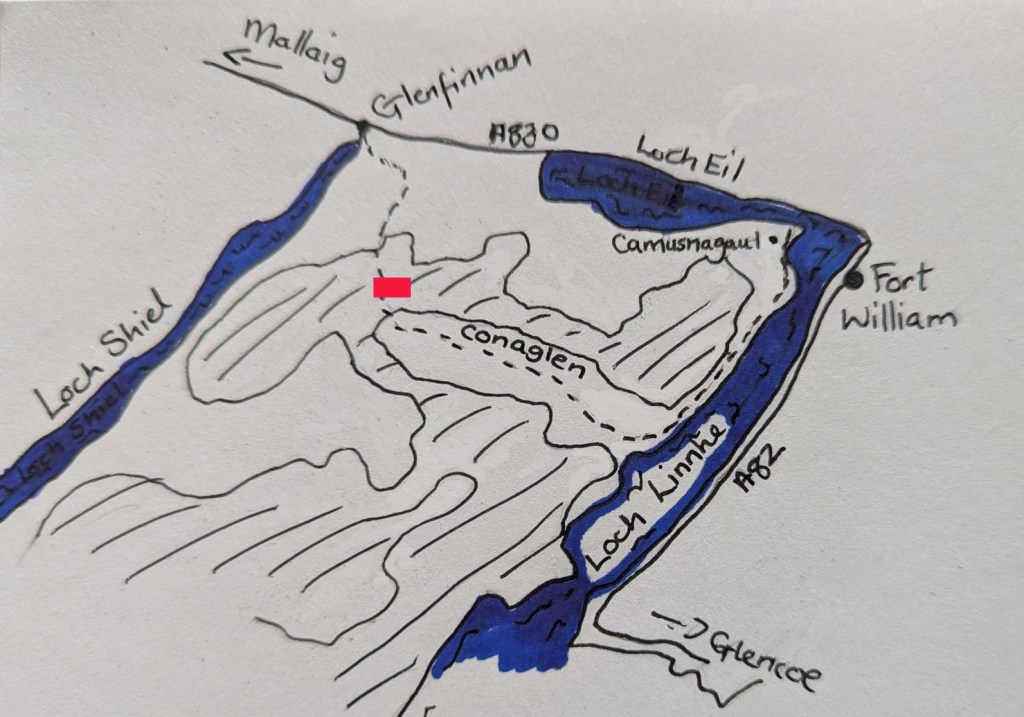
We reach the fence line and pass through a gate, presumably marking the northern boundary of Conaglen estate, though the earl of Morton once owned the next glen too. A tiny lochan marks the beginning of a new river, the Allt na Cruaiche. More deer graze intently near the lochan, blending in with the parched landscape of tan and taupe, ignoring us entirely. We are in no man’s land, a flat hiatus before passing from one valley to another, slightly claustrophobic after upper Conaglen’s generous views.
But soon enough we’re marching down, heading due north towards a marvellous panorama that takes in the hills I’ll be walking through tomorrow, their edges sharp against a serene blue sky. I hesitate, and not just because the path is now wandering through steep banks of mud. There’s something I’ve been wanting to ask Chrissie since this morning on a difficult subject that has been very much on my mind this past eighteen months or so.
‘You don’t have to answer this if you don’t want to,’ I begin. She continues to leap serenely down the slippery banks. I take this as encouragement. ‘I just wondered how you, like, cope … I mean you must see a lot of death on a cardiac ward.’
She agrees, then begins to feel her way to a powerful answer, explaining that the medical team have to decide quickly whether they can try to save the patient, or whether it’s got to the point where they’re essentially delivering palliative care, hopefully with the family’s agreement. ‘If we’ve done absolutely everything, it’s fine. Definitely a lot easier to accept. But if one of us has made a mistake or we could have done things better, that’s when I find it hard.’
I think again how remarkable she is, how much more immature and inept I was at her age. And I push away my own vivid memory of staring death in the face. Chrissie’s right. It’s much easier to accept if you have nothing to reproach yourself for. My head – and everyone else – tells me I don’t. But my heart wonders.
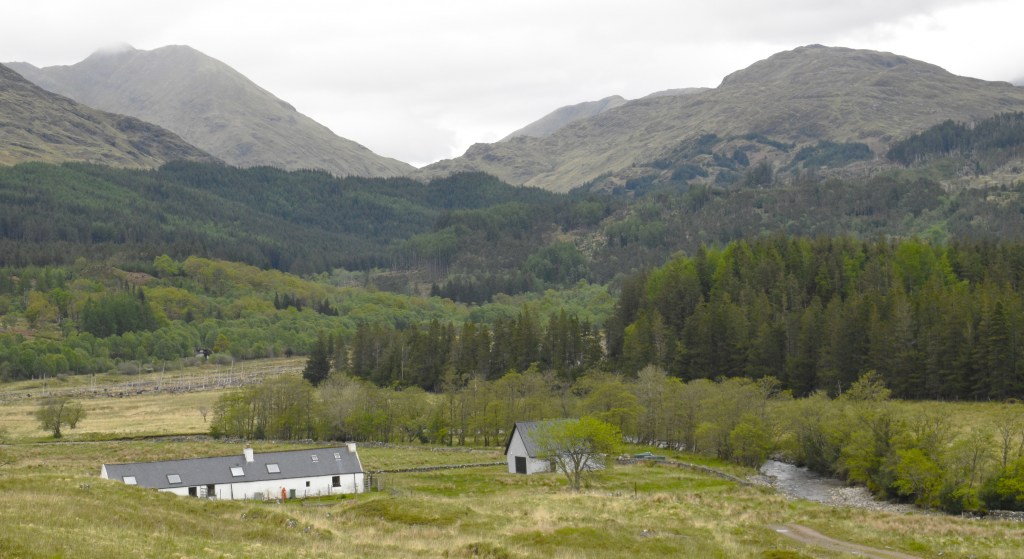
The river grows fiercer and darker, pouring over rocks with bubbly abandon. Though Glenfinnan’s not yet in sight, it’s there, round the corner, the end of today’s trail. I feel a surge of elation and relief. The trees begin again, scattered pines giving way to the dark ranks of a plantation on the other side of the river, which is now called Callop. The path is a good one and we are soon on the road at the bottom, which twists to the left, towards Loch Shiel and its famous monument to that most romantic of princes, Charles Edward Stuart.
I catch a glimpse of Loch Shiel, clouds gathering a little to subdue the light’s intensity. But it’s still hot. The path wends its way up a little hill. ‘Who put that there?’ I ask, and Chrissie laughs. I slow down, pushing heavily on my poles, mouth dry. I’ve almost had enough now. We’ve done over twenty-one miles in seven and a half hours, thanks to an easy path with no need whatsoever to navigate. It won’t always be like this.
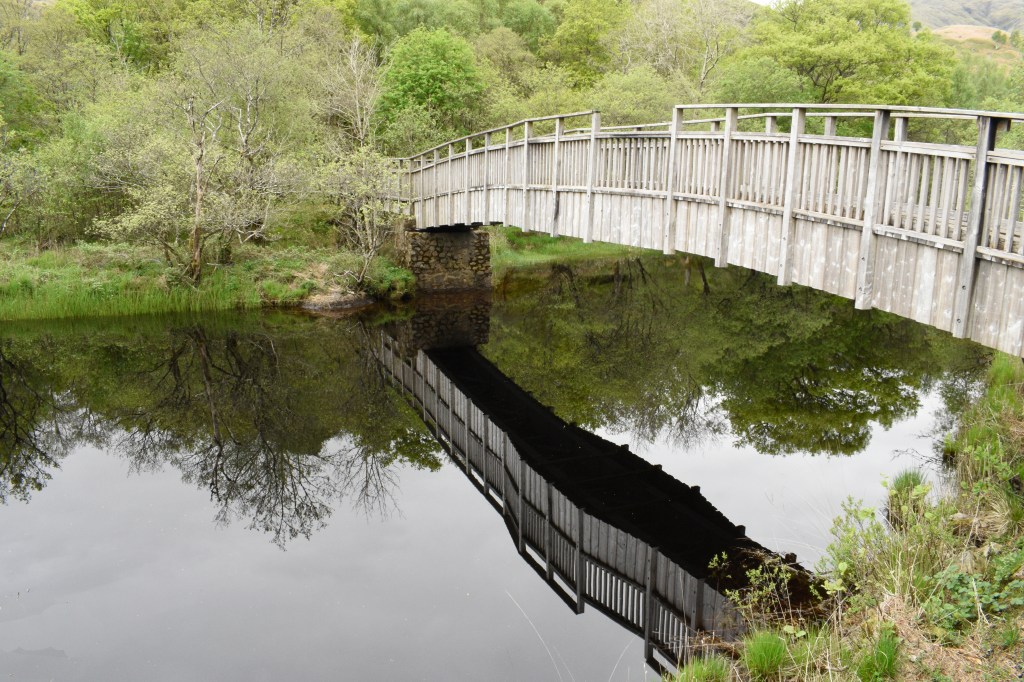
Wheesht, I tell myself. It’s not a race. With nearly three walking weeks still to go, it’s far better to take each day one at a time.The top of the hill at least affords us an excellent view due east towards Ben Nevis, still veined with patches of late winter snow. It would have been marginally quicker to walk directly from Fort William west to Glenfinnan. But that would have been horrible compared to the quiet loveliness of Cona Glen. We trot down the hill to cross a timber bridge curving over the River Finnan as it merges into the loch, a bend of land with a line of trees throwing graceful reflections into the water. A walkway meanders through a wood, the noise of cars not far away. And suddenly we are out in the open, the famous monument to Bonnie Prince Charlie a short distance away on our left at the head of the loch, the visitor centre on the other side of the road to our right.
Chrissie is going to spend the night in an old railway carriage converted into a hostel. Tomorrow she’ll meet her dad and stepmum and they’ll all carry on into Knoydart, ending up at the famous Old Forge community pub at Inverie for her birthday on Thursday. I’ll be going the more direct way through Knoydart to Barrisdale, but knowing Chrissie, she’ll catch me up. We hug and she turns to carry on along the road.
I settle on the wall beside the visitor centre, carefully switching off the tracker attached to the left-hand strap of my rucksack to save the battery. I have quite a few friends and family keeping tabs on me, so they’ll see that I’ve made it to Glenfinnan. I text a few of them, feeling quite pleased with myself now that I’m sitting down. I phone Nick, well aware that from tomorrow I’ll be out of signal until Kinlochhourn on Friday. It’s only two and a bit days, but it still catches at my heart that I won’t be able to hear his voice no matter what.
I’m putting off the inevitable – just because I’m in Glenfinnan doesn’t mean I’m done. Easing myself back onto my feet, I hoist up my pack and head across the car park in search of somewhere to pitch my tent. Every step I take now along the road that heads up Glen Finnan itself will mean fewer tomorrow. To be honest, I’d be happy to camp right here and now but it’s all concrete and some distance from the river. I walk under the viaduct, impressed with the arches soaring above me. A train trundles over, but it’s a modern(ish) diesel, not a huffing puffing steam engine. I can’t be bothered to take a photo.
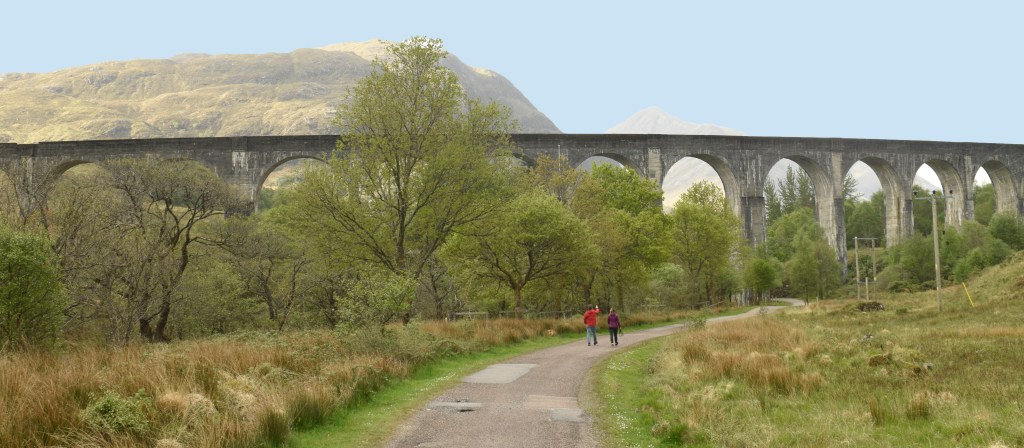
There are still a few walkers out for an evening stroll, though it’s getting cooler now. Thankfully the dreaded Scottish midgies haven’t hatched yet to plague us, though there are ticks a-plenty. I pass some houses, but there’s still nothing worth camping on apart from the grass verge. But then again, I argue with myself, the verge is broad, the river not too far away. It’s not exactly secluded, given that there’s another house and some farm buildings on the other side of the road. But it’s not as if I’m going to spend the week here.
I heave off my rucksack and manage to extract the tent. I’ve just pegged it out when a jeep full of burly young men heads out of the farmyard. I have a bad feeling. Sure enough, it slows down and one of them swings open the door and heads purposefully towards me.
‘You cannae camp there. That’s ma gairden [garden].’
‘Okay.’ I tell myself to be a grown-up, not a child on the verge of tears or a huge tantrum. ‘So where can I camp?’
He points further along the road, which veers off to the left. ‘Just round there.’
‘Oh.’ If only I’d kept going. ‘Thanks.’
He returns to his companions and the jeep charges off. Stuffing everything back in my bag, I wonder what he means by ‘just.’ But as soon as I turn the corner, I see the perfect campsite, a broad expanse of cut grass right next to the river. I grin. It doesn’t take me long to get everything up and sorted out. I even manage a quick wash, making sure my feet are properly clean. They seem to have survived the day without any serious damage.
I don’t feel hungry, but I know I must be ravenous. I reach into the pocket of my trousers for my glasses so I can see my epicurean choices. They’re not there. I look around, picking everything up. Nothing. I rush back down to the river, to the rocks I sat on to wash my feet. I’d taken off my trousers, but if my glasses did fall out of the pocket, they’re not there now. I feel really, really stupid. And really, really worried. I can see perfectly well just walking along. But I can’t read a map or decipher the GPS coordinates on my watch. I have a spare pair of glasses – I’m not that daft – but I absolutely cannot lose or break them over the next four days or I’m done for.
I extract the spare pair gingerly. Now I really must eat. I boil the water, leave the chicken tikka for eight minutes. But I can’t even get that right, crunching through bits that haven’t rehydrated because I didn’t stir it well enough. I try as hard as I can but leave about half. It’ll all be down to the porridge tomorrow morning. I tell myself I need to be more careful.
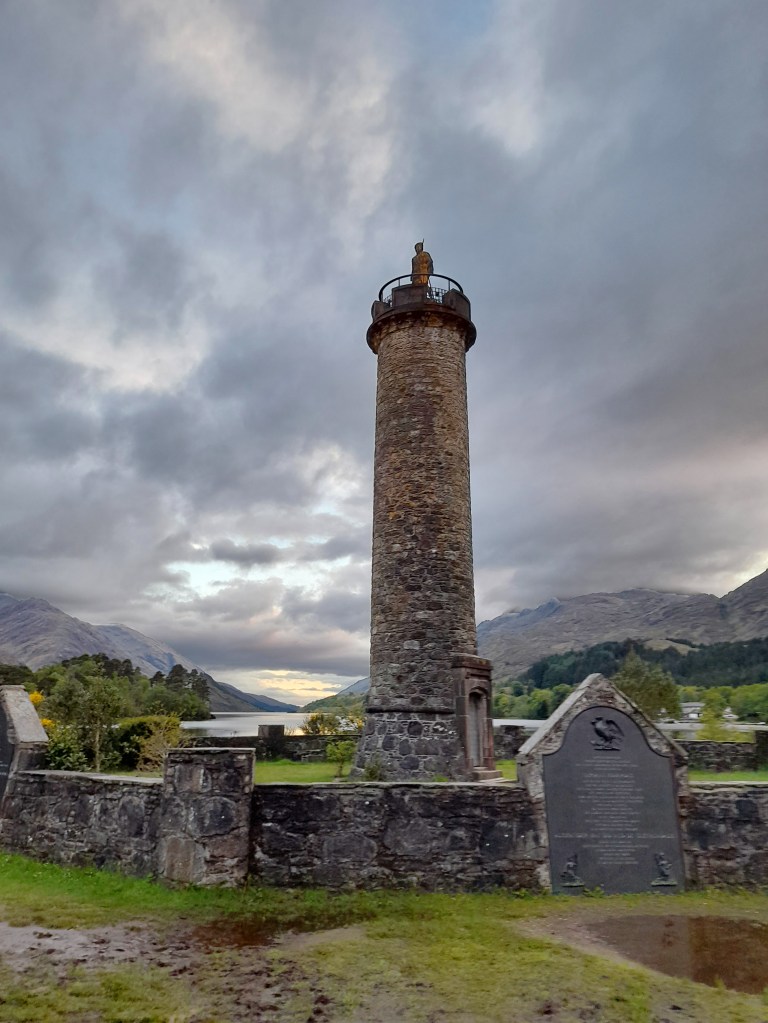
Picking up my camera, I wander back down to the visitor centre for the sunset, phoning home on the way. There’s nothing much to say that I haven’t said already, but it’s lovely to speak to both my boys, which means it’s an effort to say goodbye. I walk up to the viewpoint. It’s all a bit grey after the day’s sunshine and I’m glad I’m wearing my down jacket. I take a couple of pics looking towards the monument and down Loch Shiel, though it looks as if there’s no point in hanging around for something technicolour to miraculously appear through the cloud. The monument was commissioned in 1814 by Alexander Macdonald of Glenaladale, who also held Glenfinnan, almost exactly fifty years after the rebellion led by Prince Charles Edward Stuart. While Alexander himself was a loyal supporter of the Hanoverian family then ruling Great Britain and Ireland, his forbears had been ardent supporters of the Stuart cause.
Bonnie Prince Charlie, the twenty-five year old grandson of King James VII of Scotland and II of England, landed on the Hebridean island of Eriskay on 23 July 1745. King James had been forcibly divested of his English crown in 1688 and his Scottish crown in 1689, thanks to his Catholicism, but also his high-handedness. This smacked way too much of the behaviour of his own father, Charles I, who had provoked a civil war throughout Scotland, England and Ireland after 1639 and ultimately lost his head ten years later. Jacobitism – from the Latin version of the deposed King James’s name – had threatened yet more civil war on a number of occasions between 1688 and 1719, but all had been quiet since then. To say young Charlie had a mountain to climb in order to put his father – James Francis Edward Stuart, known as the Old Pretender – onto these thrones would be something of an understatement.
Though Bonnie Prince Charlie had been born and brought up in Italy, it was France – Protestant Britain’s great Catholic enemy – that usually provided the muscle behind any Jacobite uprisings (though the other great Catholic power, Spain, had made a spectacularly unsuccessful go of it in 1719). The ship that brought the prince to Eriskay – the Du Teillay – was undoubtedly French. But somehow he had neglected to bring an actual army with him, the mixed bag of seven or so Jacobite exiles not even amounting to a football team, never mind a fighting force likely to spook King George II, the current ruler of Britain whose father had once been merely the Elector of Hanover.
Unsurprisingly, those clan chiefs who hastened to greet the royal adventurer were less than impressed by his belief in a wing and a prayer rather than French soldiers. They advised him to go back from whence he had come, pending more serious preparations for an uprising. The Bonnie Prince was made of sterner stuff, however, setting sail two days after his arrival and anchoring first off the Scottish mainland in Loch nan Uamh some seventeen miles west of Glenfinnan. It was a tense few weeks, with few clans of substance showing any enthusiasm for such a reckless project. But at last, so the story goes, Donald Cameron of Lochiel was guilt-tripped into visiting the prince to give his apologies in person, despite his relatives warning him not to go. Once in the royal presence, Lochiel seems to have fallen hook, line and sinker for Charlie’s renowned Stuart charm, reversing his decision.
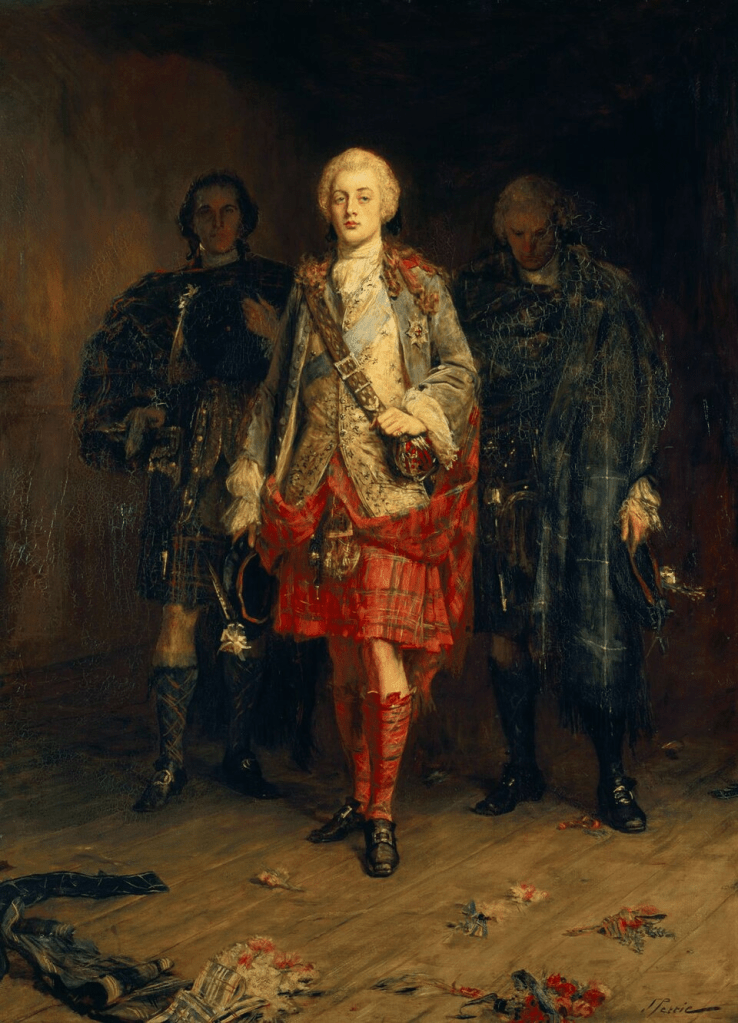
It’s tempting to view this as typically romantic and inevitable, a testament both to the prince’s magnetic personality and the highlander’s penchant for lost causes. But the Camerons of Lochiel were scarcely political ingenues. Rather, they ‘were no less commercially-minded than the Dukes of Argyll,’ whom indeed the Camerons may have resented for their control of patronage and royal favour in the highlands, perhaps hoping that regime change would alter things very much in their favour. Intent on developing Fort William as a trading centre rather than just a garrison, Lochiel and his predecessors had also dabbled in the timber market. Even now, he was scarcely dewy-eyed, extracting a promise from the prince that he would be compensated with the value of his estate should everything go pear-shaped.[i]
With Lochiel on board, a number of other clans also threw caution to the winds and began to raise men. The prince moved east, arriving at Glenfinnan on 19 August 1745. These lands belonged to Clanranald, whose family were distantly related to the Macdonalds who had once been lords of the Isles. Unlike Lochiel, the current chief, Ranald, refused to have anything to do with the prince. But he couldn’t or wouldn’t stop his son, yet another Ranald, from taking 200 men to Glenfinnan, along with a cousin, Major Alexander Macdonald of Glenaladale. Glenaladale lies nearly half way down the western side of Loch Shiel, but Major Macdonald also held Glenfinnan of his chief. And it was he who had the honour of presenting the prince with ‘a very pretty gelding,’ forcibly acquired from Captain Scott of Scotstarvet in what was reputedly the first skirmish of the campaign against two companies of government troops, presumably from Fort William, a few days earlier.
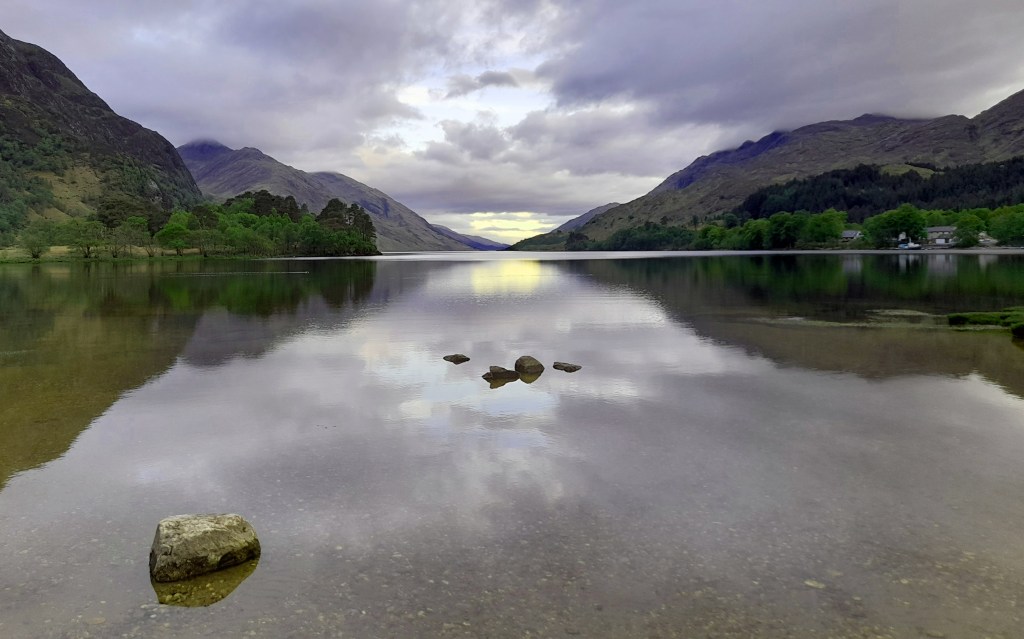
Now, at last, after nearly a month of tense negotiating, the royal standard was unfurled, a symbolic act that not only marked the formal beginning of the rebellion, but also tarred all those standing behind it as traitors so far as the government in London was concerned. In retrospect, when it had all gone horribly wrong, Macdonald of Glenaladale claimed ‘that he had never seen the prince more chearful at any time, and in higher spirits than when he had got together four or five hundred men about the standard.’[ii] And as Lochiel’s Camerons began to pour in from the various glens I will be walking through or past tomorrow, I can well imagine the euphoria here in this beautiful spot at the head of Loch Shiel.
And yet, I wonder what exactly the monument serves to commemorate. However charming and good-looking Prince Charlie was in his youth, the Stuarts believed in the Divine Right of Kings, that their royal status was given to them by God himself. And if you believe that, it’s not a big stretch to imagine that everything you think and do is also God’s Will. Many of the Highland families that flocked to Charlie’s standard had not been well-served by the Stuart monarchy in the past. Indeed, the prince’s great-great grandfather, James VI of Scotland and I of England, had viewed the north-west Highlands and Islands as a problem area that needed to be civilised into good behaviour, either by educating future chiefs in English in lowland Protestant schools or even settling lowlanders in particularly ‘difficult’ areas.
As usual, none of this worked very well. The Macleans of Ardgour and the Macdonalds of Clanranald remained steadfastly Catholic, clinging to the old ways. Perhaps, just like the lords of the Isles, the Stuarts had come to represent the Good Old Days, whether or not they ever really existed. Nostalgia is a powerful political weapon, though attempts to actually turn back the clock rarely meet with success. I wonder too if it was nostalgia that built the monument, a longing this time not necessarily to go back, but to go forward into an uncertain world of empire and industrialisation imagining that life was at least simple when they once were warriors.
Coming down from the viewpoint and walking back towards the road, I spy two girls with rucksacks, dark-haired and fresh-faced. They seem to be in a bit of a quandary, looking around, walking onto a boggy piece of grass next to the visitors’ centre car park. I hail them, ask if they’re doing the Cape Wrath trail. They look bewildered, so I tell them if they’re looking for a campsite and don’t mind walking for ten minutes, I know an excellent one. They’re from Germany, students in different universities now, but old schoolfriends whose boyfriends don’t like walking. They’ve come on a Harry Potter pilgrimage but are going back to Fort William tomorrow to start the West Highland Way.
How are you finding Scotland so far? I ask, fishing for compliments as if anything praiseworthy was all down to me.
They nod enthusiastically. Lovely. But so cold at night.
I smile. They’re young. Maybe not as tough as we Scots. They’re delighted with the campsite and I leave them to sort themselves out. It’s getting dark now. I crawl into my sleeping bag, very ready for sleep. Apart from some German murmuring, I can hear only the river. Oh, and a tawny owl calling to her mate. I’m very happy to leave the night to them.
[i] T.C. Smout, Alan R. MacDonald & Fiona Watson, The Native Woodlands of Scotland, 1500-1920 (Edinburgh, 2005), p.192, p.203, p.295, p.345; Allan I. Macinnes, Clanship, Commerce and the House of Stuart, 1603-1788 (East Linton, 1996), p.226;Jacqueline Riding, Jacobites: A New History of the 45 rebellion (London, 2016), pp.465-7
[ii] Robert Forbes, The Lyon in Mourning, ed., William Paton, (Edinburgh, 1895), vol. 1, p.207
 The Other Side of Wild: Walking through Time and Space on the Cape Wrath Trail
Leave a comment