

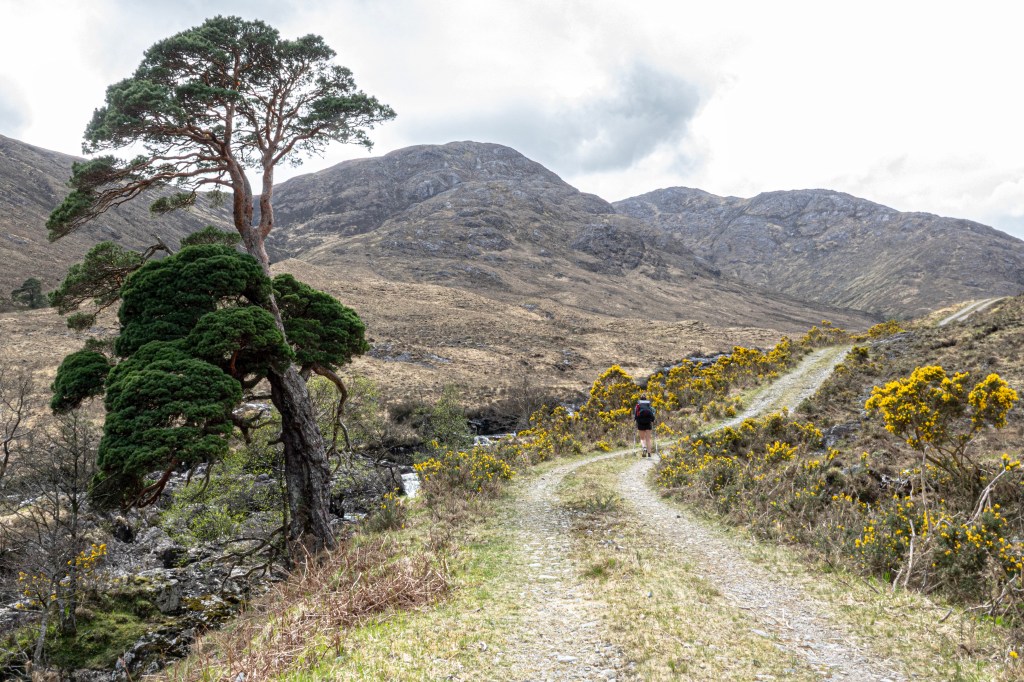
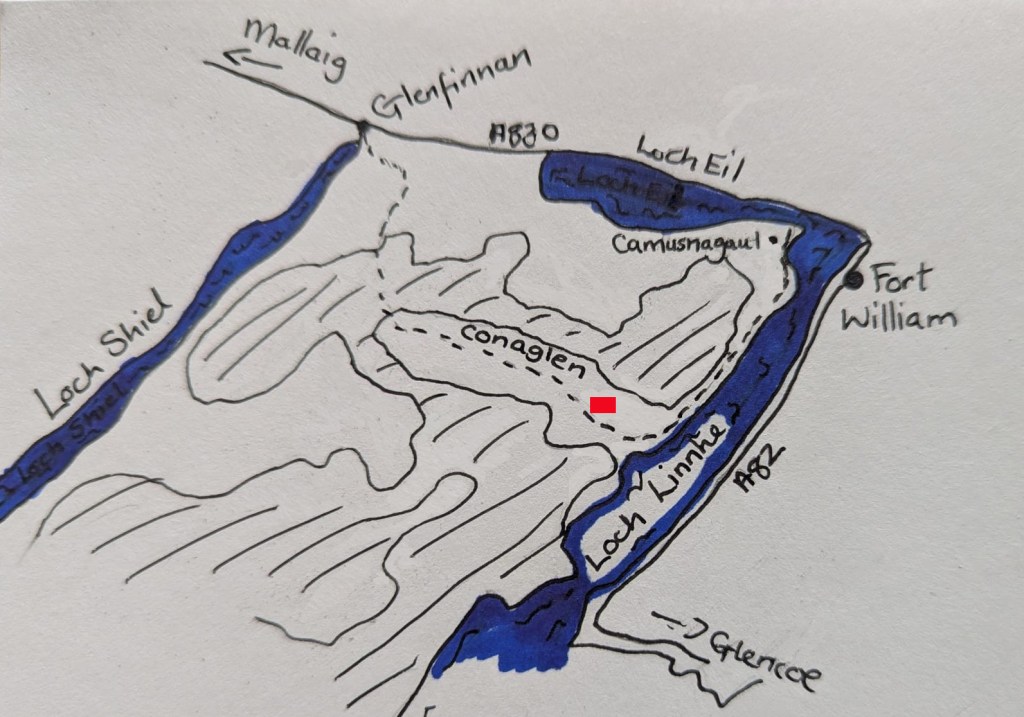
Chrissie and I start to climb a little out of the manicured surroundings of Conaglen House, edging out of the trees with the broad sweep of the River Cona chuckling merrily to our left. To our right, a graveyard of tree stumps pokes out of a morass of dried mud. Such skeletons are usually ancient, brought down by a change in climate hundreds or even thousands of years ago to wetter, colder conditions that encouraged the spread of peat. But some four hundred years ago Conaglen was still renowned for its trees; not the oaks of the lower glen, but the pines whose sporadic descendants we can now see ahead of us.
Around 1630 a survey of ‘certain pairts of the Highlands of Scotland’ noted that here were ‘… a great number of firr (pine) trees … and there is a water in the glen which doeth transport great trees of firr and masts to the seasyde’ The same was true for neighbouring Glen Scaddle, so that ‘There uses manie shipps to come to that Countrie of Ardgoure, and to be loadned with firr Jests Masts and Cutts’ [Many ships are accustomed to come to that country of Ardgour and be loaded up with pine joists, masts and lengths of timber].[i] The English, and then (after the Union of the Scottish and English parliaments in 1707) the British, navy had an insatiable need for timber for ships in those days, though many Highland glens proved too remote to make it worthwhile exploiting, however impressive their trees.
The pines still dotting the upper glen are certainly lofty, if lonely, specimens. When they were surveyed in the 1950s by Henry Steven, professor of forestry at Aberdeen University, and his research assistant, Alan Carlisle, the pair concluded that the oldest was then a venerable 210, so perhaps seeded only a century after the 1630 survey. Most were between 90 and 140 years. But Steven and Carlisle were very worried by the scarcity of seedlings from which the next generation might spring.[ii]
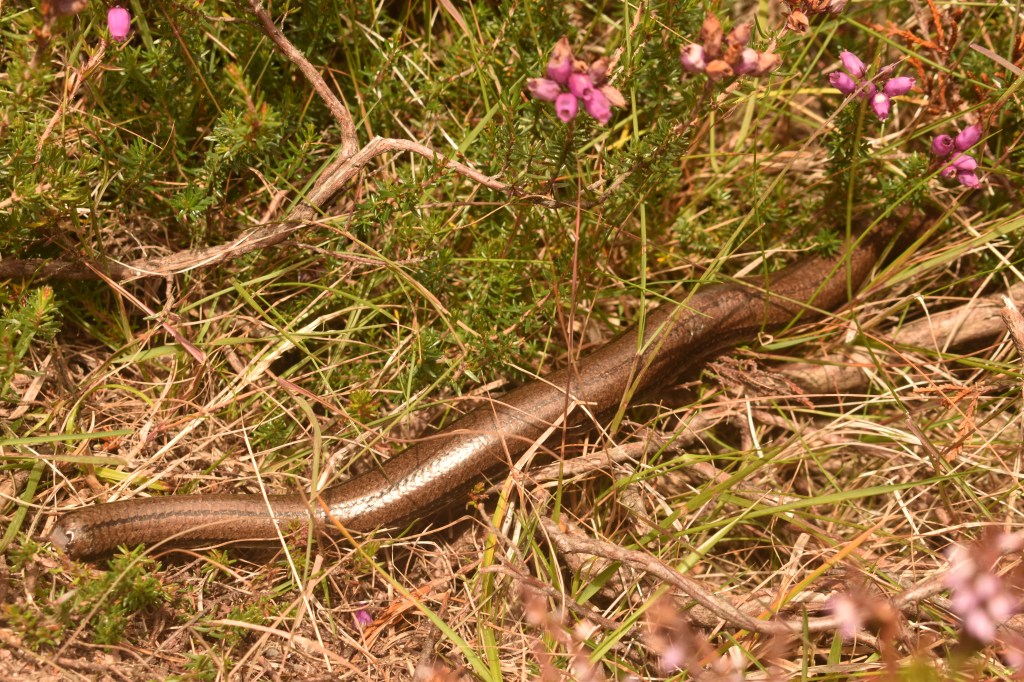
Something stirs on the path and we both jump. For a split second, I think it’s an adder, but as it slithers off into the heather, I can see it’s a slow worm. That’s actually a misnomer, because it’s not a worm either but a kind of lizard without any legs. Since I’ve only ever seen one before, I’m pleased, though I wouldn’t say I find them particularly attractive, unlike the usual kinds of lizard. I love them. I even have a lizard tattoo. They remind me of the hot places of southern Europe, where I usually see them (though we do have them in Scotland). And, like my mum, I love hot places.
I turn round and look back, impressed with how far we’ve come. We’re definitely more than half way, probably about 11 or 12 miles in. I like it here, among the pines, decaying like graceful old dowagers, and the fragrant, vibrant gorse bushes. The afternoon is wearing on, the heat still rising. Next to us the Cona River looks most inviting, a small waterfall spilling into a pool of crystal clear water. ‘Another time,’ Chrissie says, pulling herself away. I nod, wondering how likely it is I’ll ever be here again. Looking ahead, we can see the line of the hillside we’ll have to climb before crossing over to begin our descent towards Glenfinnan. It’s still some distance away, but we’re definitely getting there. I’m glad. I’m hot and tired.
‘Do you think we’ll see the Harry Potter train?’ Chrissie wonders. The famous steam train crosses the Glenfinnan viaduct at 4.20 pm. I’m optimistic we might make it time-wise, but I’m not sure, from what I remember of the map, that we’ll be able to see the viaduct as we come down the hillside. I’m think we’ll be too far east. I smile, thinking of the tiny dark-haired Hermione, wand in hand, I encountered in the station at Fort William this morning when Nick, Finn and I went for a coffee. She was so wrapped in her own thoughts, presumably of wizardry and wonder, so utterly unaware of where she was and what was going on around her, I had a job to squeeze past to get to the café and one last bacon roll. And that truly is magic.
The path twists and turns as the surrounding mountains creep closer. But we’re no longer alone as half a dozen eyes swivel in our direction. A small herd of red deer has been grazing, heads down, but now they weigh us up, unsure of our intentions, though not so wary as to actually move. Given that we haven’t seen a soul since we left the road (and precious few before then, apart from in passing vehicles), I don’t suppose they receive many human visitors. We keep walking, so close we’re almost within touching distance, and at last the nearest pair skitter away, though only for a few steps. But apart from keeping an eye on us, they’re seriously unbothered. The rest have already resumed their munching. They’re in the right place – the hill above them is called Meall nan Damh. Stag’s hill.
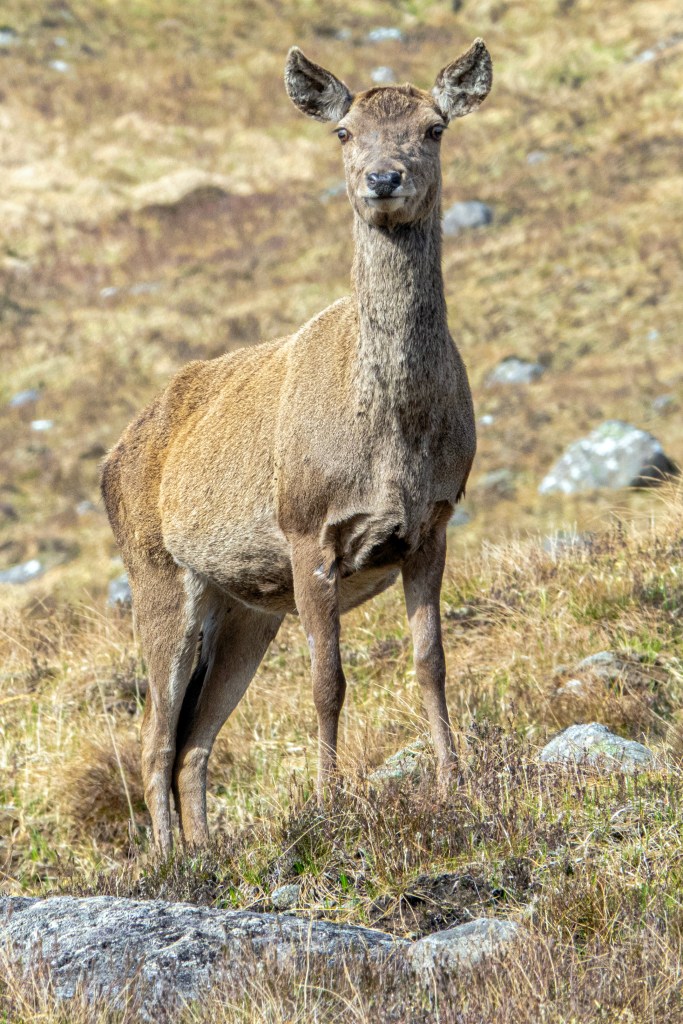
And here we have it, the most likely culprits for the lack of seedlings and young trees noted by Stevens and Carlisle. When the Conaglen estate was sold to the earl of Morton in 1860, the numbers of sheep and deer increased. It was unusual to have both, though I suspect the sheep were kept on the slopes lower down and the earl and his guests at Conaglen House came here to the upper glen to indulge in the upper-class craze of the age: deer stalking.
Unlike other parts of Europe and the rest of the Anglophone world, hunting for sport tends to be an aristocratic pursuit in the UK, or at least one restricted to the wealthy, who pay handsomely to shoot deer, grouse, duck or pheasant. Even so, the lack of predators has led to deer numbers skyrocketing on Scottish estates. According to a recent report by Land and Forestry Scotland ‘there are now over 1 million. That is double the number there were in 1990.’ This is a serious threat to Scotland’s trees, for deer do love to nibble at seedlings and peel off tree bark, exposing them to disease. Since deer stalking these days doesn’t kill enough of them, many landowners set culling targets to bring numbers down to a level that will protect trees and, so the theory goes, make the deer populations themselves healthier.[iii]
The Maclean chiefs of Ardgour would surely have been bemused at the need to take such drastic action, for Highland hunts were often large-scale and bloody. Conaglen and Glen Scaddle were their favourite haunts. ‘Cona’ comes from the Gaelic word for dogs, by which I don’t mean the kind of pampered pooch that lies on our deck all day when he’s not barking at our neighbours’ hounds, but well-trained and equally beloved hunting dogs.
The first Donald to come to Ardgour so enjoyed the sport that he was called ‘the hunter’ [Dòmhnall an sealgair]. He also gave his name to the peak in Glen Scaddle that we could see in the distance from the boating pond at the bottom of Cona Glen. Alas, the story goes that this was where he met his death, for one day, when he was out by himself on the eastern flanks of Sgurr Dhomhnuill, he was gored by a stag or, because no-one really knows, slipped in pursuit of one. Either way, that was the end of Donald.
A century or so later, Ewen, sixth laird of Ardgour, was known as Ewen of the feathers [Eòghainn nan itean], suggesting he was a dab hand with a bow and arrow. His grandson, another Ewen, was so eager for the chase that he managed to give himself a permanent limp after spraining his foot. His old nurse tried to cheer him up by recounting his days on the hill.
Often my love was there
With his gillies at the knoll’s back.
Beinn a’ Mheadhain [in Glen Scaddle] of the green grass
Where the mist diffused before the sun rises,
Often you were on her high top,
On your elbow aiming at the deer.[iv]
Personally, I don’t think banging on about the glory days was all that likely to make Ewen feel better, but I’m sure she meant well. There’s certainly no doubt that hunting was a vital part of Gaelic culture, a pursuit shared with elites across the world. Apart from anything else, it was a way of showing off with lavish hospitality and no doubt engaging in a bit of informal diplomacy of the kind that is reputedly done these days on the golf course. But for clan chiefs and their fine, it was also a way of honing their fighting skills with an eye on acquiring a reputation for strength, courage and resilience.
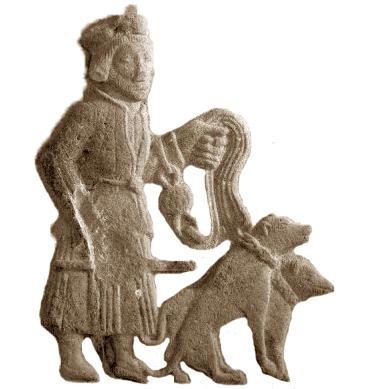
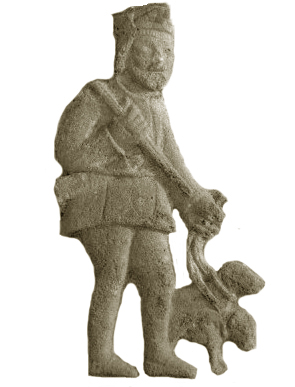
The hunter in the poem seems to have gone stalking on his own apart from his dogs. And even Ewen the eighth laird was up on Beinn Mheadhoin, gun cocked, accompanied only by his gillies. That sounds like the kind of hunt where you take a sniff at the weather and decide to get up early the next morning; the kind to keep you in shape and perhaps give you a bit of a reputation as a tough, dedicated hunter prepared to walk miles depending on where the deer might be. And as Donald the Hunter found to his cost, it could be a risky business.
But if you really wanted your reputation to go out and kick ass, you needed to stage a drive. These could be enormous affairs, requiring the services of hundreds, if not thousands, of mostly, but not exclusively, men. Presumably most of the chief’s tenants were told to attend, as well as specialists such as foresters, butchers, dog-men, and, of course, the poets who would turn the hunt into an epic adventure. The Macleans of Ardgour weren’t rich enough lords to put on a truly spectacular drive, unlike their cousins, the Macleans of Duart. But they would surely have put on a decent show.
Drives had a very long tradition in the Gaelic world and, most unusually, were adopted by the Norman nobility who arrived in south-east Scotland in the twelfth century at the invitation of the Scottish king, David I. Though many Norman customs and social norms slowly seeped through much of Scotland as the newcomers were absorbed into Scottish society, the traditional method of hunting survived. In England and western Europe, the nobility hunted par force, sending out dogs to track down and chase the deer or other prey until it was exhausted, whereupon the king or most important nobleman moved in for the kill with sword or spear at considerable personal risk.
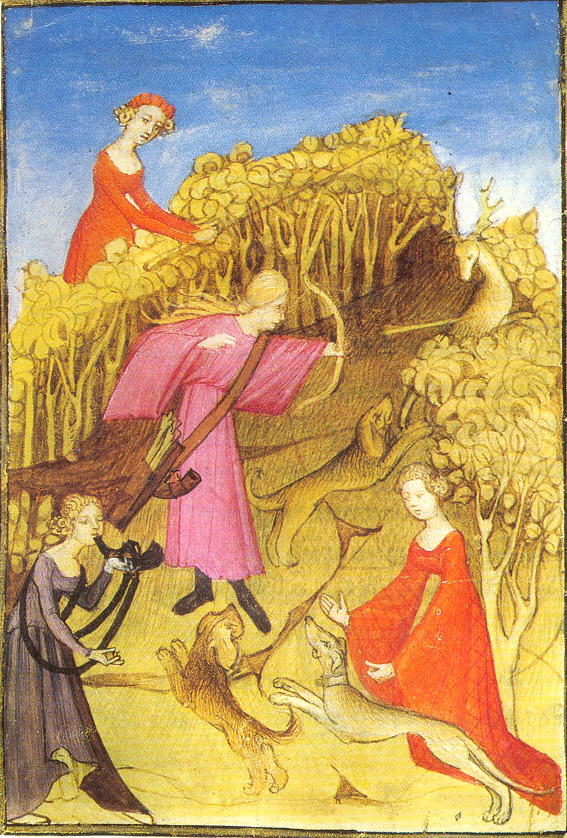
The drive, on the other hand, used men to propel the deer in a pre-determined direction using natural features (steep, narrow glens, for example) or a specially-constructed wall (called an elrig or elrick). The hunters might wait in a turf and stone enclosure called a tigh ‘n sealg (hunting house), or on an eminence like ‘the knoll’s back,’ where Ewen the eighth laird of Ardgour lurked, and used dirks, bows, spears and eventually guns. Whatever form of ambush was used, it’s easy to imagine a complete bloodbath.[vi]
But these were the glory days, and while I’m sure the Macleans presumed – as we so often do – that they would go on forever, their patrons, the lords of the Isles, were about to lose their lands and position in spectacular fashion. In 1463 the Scottish government confiscated the earldom of Ross after John, the fourth lord, was caught out in a treacherous treaty with the English king, Edward IV.
It could have been worse, and it soon was. For now John’s son and heir, Angus Óg – outraged at the loss of these lands – went on the warpath, kicking his father out of Islay, the island at the heart of their empire. The final act came in 1493, when the next king, James IV, dismantled the lordship, giving poor, impotent John a pension and somewhere to live well away from his volatile homeland.
Given how close they were to the Lords of the Isles and how much loyalty was in their DNA, the Macleans of Duart, along with their cousins of Ardgour, backed the Macdonalds to begin with. But their loyalty wasn’t blind to political reality. Once John lost control to his son and the western seaboard ignited into turmoil, they couldn’t afford to be sentimental. All the same, it required nerves of steel and, if possible, a fair bit of second sight to decide what to do.[vii]
In the immediate aftermath of the dismantling of the lordship, the Scottish king put a huge amount of effort into meddling in north-west Highland and Island affairs, only to withdraw when James suddenly remembered he had the rest of the country to govern too. Into this power vacuum stepped two powerful families – the Campbells of Argyll and the Gordon earls of Huntly – with another, the Mackenzies of Kintail, waiting in the wings.
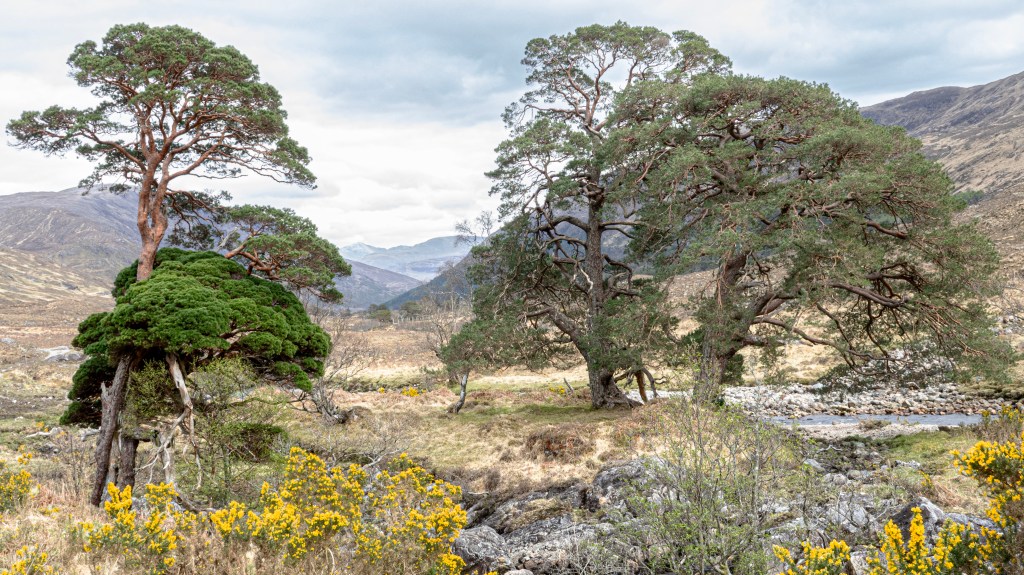
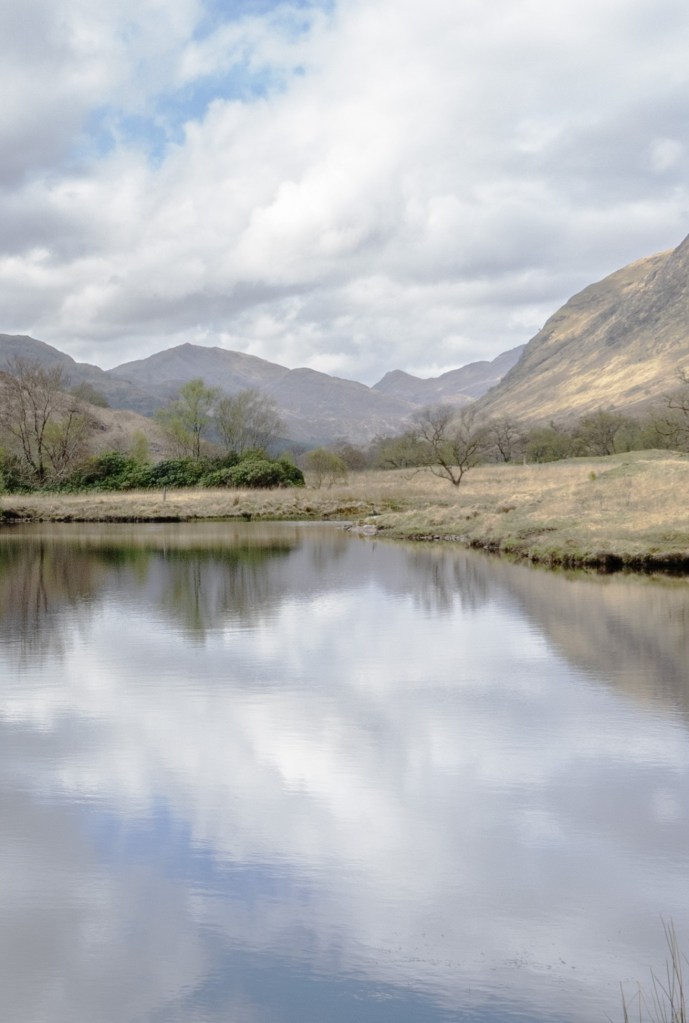
I look back down the glen, the hills on the other side of Loch Linnhe hazy in the far distance. Apart from the birds and the gurgling river, there is only quiet. I try to imagine it quivering with the movement of men and beasts, the barking of dogs and men shouting, the sonorous blasts of hunting horns. It must have been so exciting, even if the men and boys driving the deer must surely have tired eventually, muscles aching, breath evasive and unruly. And how did the hunters feel as they waited, listening hard, perhaps eager and apprehensive at the same time? But once the killing started, there would be no time for thinking about anything other than bringing death to the frantic, terrified beasts all around. I cannot help but see it as an uneven contest, and yet it was meant to be a test of mettle, warrior against worthy adversary.
Just like me and the Cape Wrath trail. Without the death bit. And I’m not much of a warrior. But sometimes the Trail has felt like a great beast out there, taking over my mind, psyching me out. There was even a time, some months ago, when I imagined injuring myself in some entirely irreproachable way that would leave me with no choice but to back out, poor me. In such moments, I had to remind myself that I wanted to do this, that it was no-one’s idea but mine. Yes, it would be hard. It was supposed to be hard. But in the end, all I had to do was put one step in front of the other. Thankfully, as I got more and more training miles under my belt, the great beast retreated to the back of my mind, and the excitement gathered. But it was a good reminder that much of the challenge won’t be the aching muscles, the inevitable weariness, the fear of getting my navigation wrong, or having to confront a raging river. It will be the little monstrous voice inside my head telling me I can’t do it.
I turn back to the route ahead. At last the path begins to steepen, heading towards the bealach, which is both good news and bad. I’m pretty sure we won’t make it in time for the train. And I’m definitely beginning to tire. But, flinging my poles rhythmically in front of me, I’m pleasantly surprised at my steady pace. And, though Conaglen has been lovely, it’s always thrilling to find out what’s next.
[i] Macfarlane, Geographical Collections, ii, p.165
[ii] H M Stevens and A Carlisle, The Native Pinewoods of Scotland (Edinburgh and London, 1959), p.172 onwards
[iii] https://forestryandland.gov.scot/what-we-do/about-us/corporate-information/deer-management#:~:text=We%20estimate%20there%20are%20now%20over%201%20million,per%20square%20kilometre%20on%20the%20land%20we%20manage
[iv] Quoted in Andrew E M Wiseman, Chasing the Deer: Hunting Iconography, Literature and Tradition of the Scottish Highlands, University of Edinburgh Ph.D thesis (2007), pp.179-180
[v] Wiseman, Chasing the Deer, p.159
[vi] Wiseman, Chasing the Deer, p.264; John Gilbert, Hunting and Hunting reserves in medieval Scotland, (Edinburgh, 1979); Iain Thorber, ‘Lament for old Donald the Hunter,’ The Oban Times (7 April 2022), p.22
[vii] See Norman Macdougall, ‘Ross, the Isles and the Stewart Kings’ in Alba. Celtic Scotland in the Medieval Era, E J Cowan and R Andrew Macdonald, eds. (East Linton, 2000), pp.248-275
 The Other Side of Wild: Walking through Time and Space on the Cape Wrath Trail
Leave a comment