

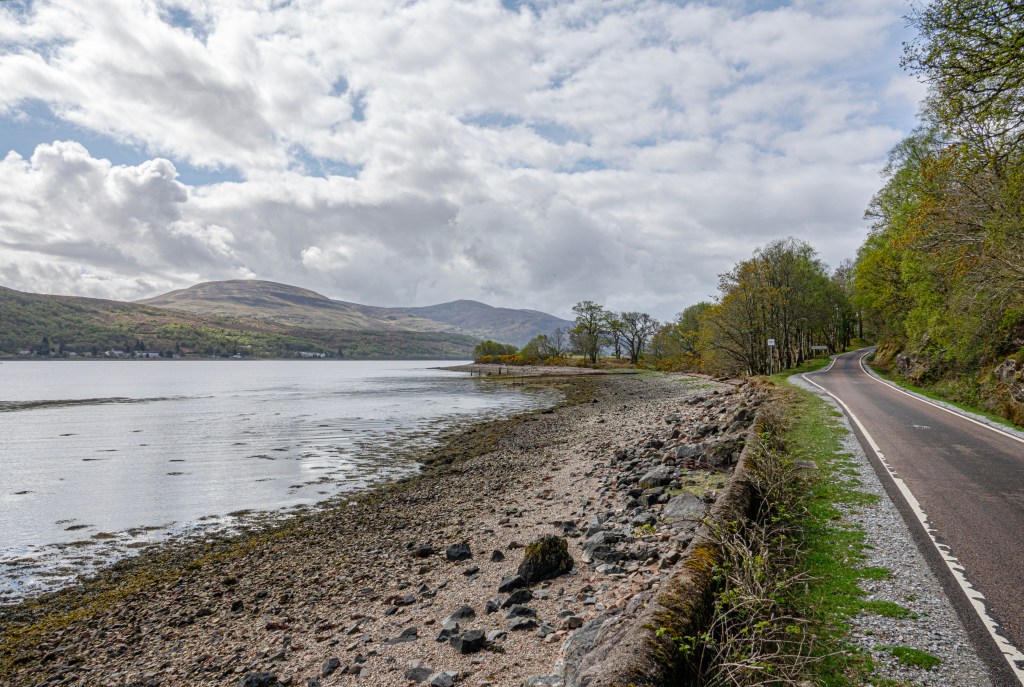
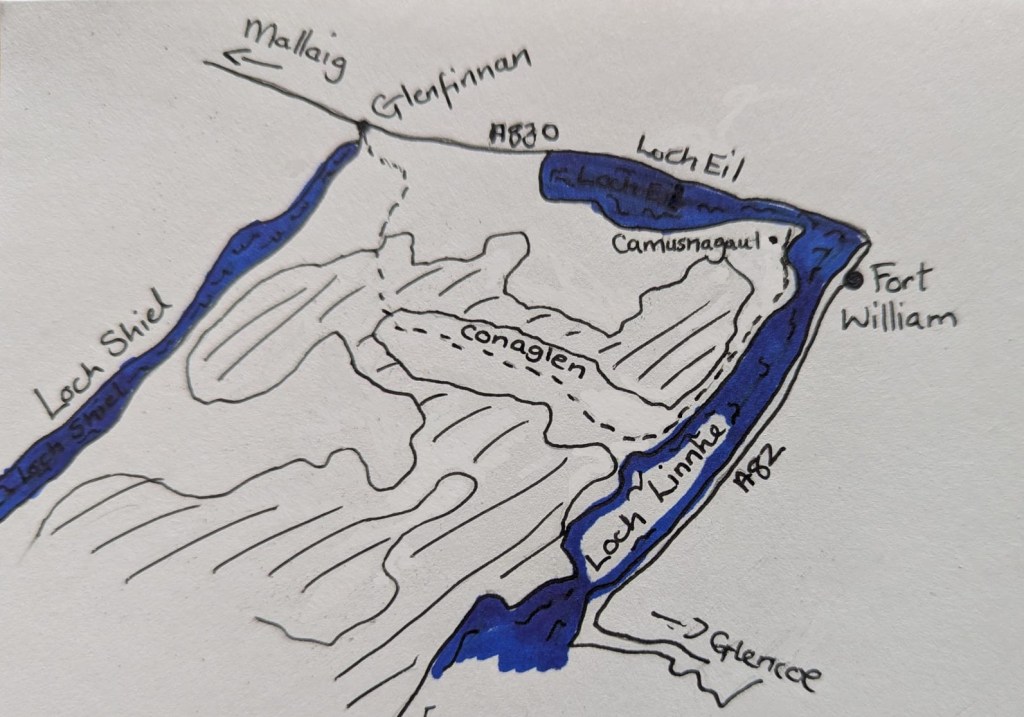
Back in Camusnagaul, Chrissie and I leave our new-found friends as abruptly as we found them, heading off down the quiet road on the west side of Loch Linnhe. This would be annoying if you stopped to think about it, given that it wends its way south for six miles when we’re supposed to be heading north. But we’re too busy chatting. The noise of Fort William still reaches us occasionally, a police siren here, vigorous hammering there. But soon all is serene. Until a huge lorry forces us to shrink into the grass verge. It’s not too much longer till another one growls up behind us. And another. It’s a long way round from Fort William for them, some thirty miles on roads built for lesser beasts. The Corran car ferry ten miles south of Camusnagaul is big enough only for cars, so needs must.
This is Ardgour, the high place of the goats. In Robert Louis Stevenson’s classic adventure story, Kidnapped, David Balfour passes through it en route to Appin on the other side of Loch Linnhe, the home of his fellow adventurer, Alan Breck Stewart. He was not very impressed, for ‘The sun was already gone from the desert mountains of Ardgour upon the hither side, but shone on those of Appin on the farther; the loch lay as still as a lake, only the gulls were crying round the sides of it; and the whole place seemed solemn and uncouth.’ Speak for yourself, Mr Balfour. I’m looking forward to seeing the Ardgour mountains, which will surely be dappled with sunshine this fair morning.
But we can’t see them yet. No wild goats either, though the local tourist board insists they’re still to be found. It’s getting hot, the blue sky slowly magicking away the clouds, great splashes of pure white light spilling onto the water. The road slices through the sharp angles of a band of rock, great oaks hanging over us on both sides, ash and hazel filling in the gaps. The grass verges are neatly cut, chiffon-yellow primroses and constellations of white stitchwort nestling comfortably where verge meets rock. A stoney beach joins us on our left, a row of houses, neat grassy fields on our right. It’s all richly verdant, as if Spring itself has come to cheer us on.
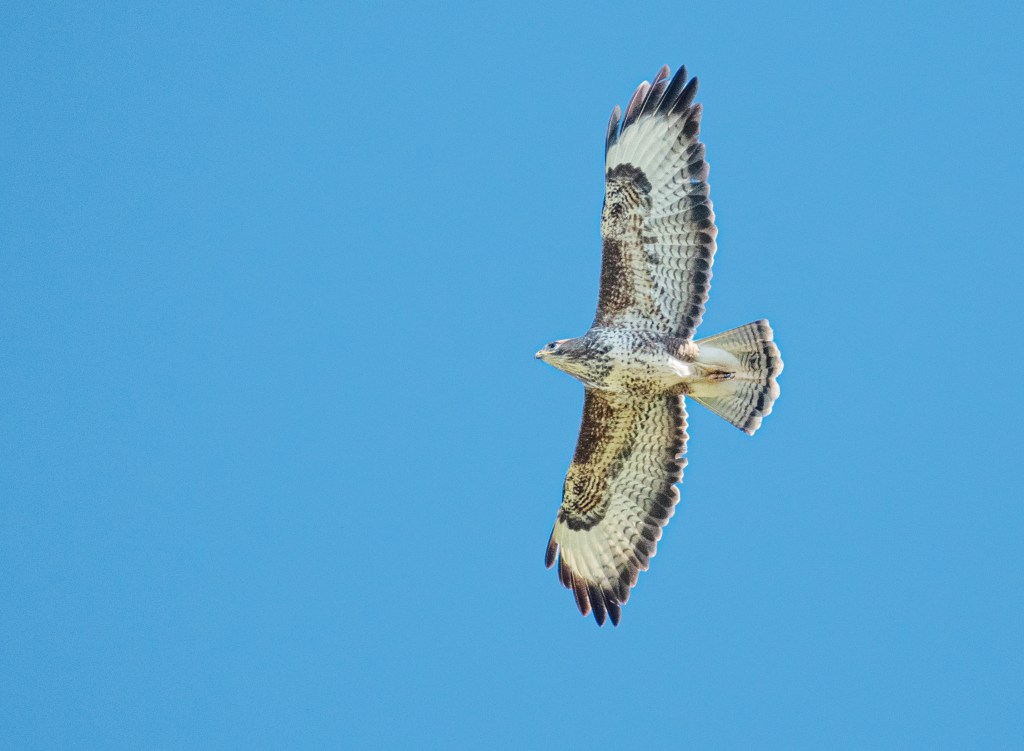
But these pleasantly populated, quiet places are getting on with life in the shadow of the past – stone walls left to decay peacefully behind newer fences, an ancient bridge going nowhere alongside the new road, old houses sinking into the ground or brought to life in expensive new-builds. A buzzard flies across the road before settling on a nearby telegraph pole. They’re very common these days, having pushed out the graceful, hovering kestrels that used to frequent the sides of roads in my youth. But buzzards are impressive too with their keen eyes and scimitar-like beaks, even if they can be chased off by a determined crow less than half their size.
Chrissie and I have chatted so hard, about what we do – she’s a nurse on a cardiology ward – our families, our lives in the hills, that I’m pleasantly surprised to see a gate on our right marked ‘Conaglen estate.’ Our route will take us up Cona Glen itself, though not quite yet. At last there’s a hint of hills, bare lower slopes giving way to darker, rockier facades just visible beyond. Gorse bushes, powerfully yellow and reeking of coconut, are free to run riot now that the rough pasture has crept up to the road, replacing the richly packed verges nearer Camusnagaul. And then the trees return, straight, spindly pines towering over sweeping banks of rhododendron in bridesmaid pink, a dead giveaway that we’re somewhere near the ‘big house’.
A road leads off to the right through a dense clump of trees, both natives and exotics. With a low wall on both sides, it hints at something a bit more impressive than farm buildings. As the main road veers left, the view suddenly opens up again. And there on the right, at the end of a grassy field and set in a well-manicured lawn, sits Conaglen House. It was built in 1862 as a hunting lodge for the Douglas earl of Morton, who had bought the Conaglen estate four years earlier.
To be honest, it looks more like a miniature mansion house or country seat, though it’s hard to tell the difference with some hunting lodges. And if you’ve got a spare £7000 and a rugby team of mates, you can rent it and enjoy some fishing or mountain biking or clay pigeon shooting before being served dinner made by your very own, if strictly temporary, chef. And if you don’t immediately fall asleep on one of the voluminous sofas in the drawing room, there’s table tennis, billiards, even a piano to play.
But this is merely the tip of the iceberg of a much longer history, for buried beneath the kitchen block are fragments of the house once occupied by the Macleans of Inverscaddle.[i] The rest of Ardgour was – and still is – owned by the senior line of the family, as it has been for over five hundred years.
Like any self-respecting clan, the Macleans’ arrival in this part of the world is shrouded in mystery wrapped in an enigma and a generous dose of hogwash. The ‘original’ lords of Ardgour supposedly lived some three miles further south, where the Corran ferry comes in. But they made the mistake of building a ‘safe house’ on an island in a little loch nearby. Unfortunately for them, this little loch was home to a ‘terrible and most fearfull Monstrous beast’ which ‘overwhelmit and destroyit the island, and so they all were perished and devoured.’[ii] Leaving aside any mundane speculation that this was really some kind of tidal surge or mini tsunami, it’s a salutary reminder of the need to check for big beasties before you build your stronghold. Unfortunately for modern tourism in Ardgour, this one didn’t stick around long enough to become famous, like its cousin in Loch Ness.
Next to take over were the MacMasters. In 1410, according to the stories, their chief was an old and unpleasant man with no friends and a fair few enemies. Of the latter, by far the most powerful was Alexander Macdonald, third Lord of the Isles, whose family had long controlled much of the north-west seaboard from their base on the island of Islay. It so happened that one of Macdonald’s right-hand men, Lachlan ‘Pot-bellied’ [Bronnach] Maclean, who held the castle of Duart on the island of Mull, came looking for some land for his youngest boy. Or perhaps his eldest, but illegitimate, son. Either way, the lad was called Donald.
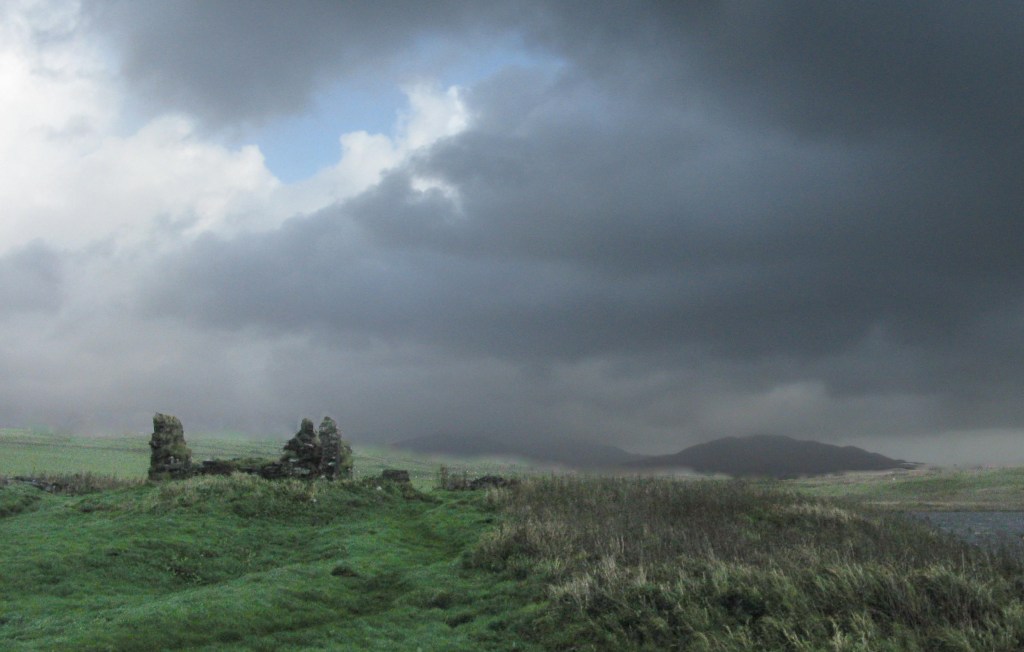
The Lord of the Isles, rather than coming out with a well-measured and straightforward response like a normal person, urged Donald Maclean to ‘Leap the wall where it is lowest.’ Somehow the young man inferred from this that he had carte blanche to take Ardgour from its current unpopular lord. Cue much bloodshed, including the hanging – or, alternatively, decapitation with an axe – of the disloyal ferryman who eagerly revealed MacMaster’s hiding place. Loyalty, even to an enemy, was a virtue that was high prized.[iii]
So far, so exciting, if barbaric. But if the origins of the Macleans in Ardgour were left to historians rather than story-tellers, we’d have a pretty poor tale to tell. Donald Maclean does exist in the historical record, but only just and more than fifty years after the traditional tales say he so brutally acquired Ardgour. In November 1466 he – along with his father, Lachlan ‘Bronnach’ of Duart – witnessed a charter authorising a land grant made by Alexander Macdonald’s son John, fourth lord of the Isles and earl of Ross, at Dingwall over eighty miles of mountain and moor north-east of here.
But it was Donald’s son Ewen who really immersed himself in north-west highland politics, witnessing charters several years before his father as steward of Macdonald of the Isles’ household, an important office traditionally held by the Macleans of Duart. Ardgour might feel like a tranquil backwater now, but its late medieval owners had no problem travelling difficult distances to stay in the thick of things. It was an even simpler matter to reach the lord of the Isles’ home, for Ewen only needed to sail south down Loch Linnhe, passing by his grandfather’s mighty castle of Duart on the eastern-most tip of Mull and on past Jura to Islay. And though he’d lost his office of steward to his uncle Lachlan, the Duart heir, by 1471, he remained part of Earl John Macdonald’s inner circle. A year later, Ewen finally became lord of Ardgour, presumably on Donald’s death.[iv]
If this all sounds a tad incestuous, then it was, and deliberately so. The Macleans of Duart were key members of the lords of the Isles’ council, below only the main Macdonald families. Naturally, the Macleans of Ardgour, as a junior branch of the Macleans of Duart, formed part of this magic circle, if at a lower level. But there was a quid pro quo. They formed part of the lords of the Isles’ management team, helping to administer justice, giving advice on weighty matters and turning out fighting men. In return, they gained lands and offices and were well-protected, out in the field and in the law courts.
In all this, they were just like other lords in later medieval Europe even if family may have played a more important role in power politics and social networks. It’s also why the ruthless end meted out to the Corran ferryman when Donald took Ardgour with the encouragement of the lord of the Isles is rather more than a gruesome bit of extra colour. The short crossing of Loch Linnhe at its narrowest point just south of the bay Chrissie and I have just reached was of great strategic importance in giving those coming from the surrounding peninsulas and islands access to the rest of mainland Scotland. And the lord of the Isles – the biggest power in the north-west highlands – needed to be sure that the man who controlled it, and appointed the ferryman, could be trusted, which by definition meant that he should come from the right family.
And as I take in the sweep of Inverscaddle Bay, utterly immersed in the here and now so that even home seems a world away, it strikes me that these highland noblemen were most definitely not playing their politics on the periphery, however far away they were from the royal court in the south and east of the kingdom. What did Edinburgh or Perth mean to them, when the meetings and social gatherings that mattered were taking place at Finlaggan on Islay or Dingwall in the earldom of Ross?
There has certainly been some pushback in recent decades against the longstanding view of the Highlands as essentially backwards, both economically and socially. In the first place, given the undoubted limitations of Highland soils, agricultural activity was governed by the sensible practice of ‘souming and rouming’, which regulated both the planting of crops and the numbers of animals that could be grazed, a system remarkably like more modern notions of ecological carrying capacity. It must also be said that the backbone of the Highland economy even in the later eighteenth century was certainly not crop production – that would be silly in most of these soils – but the black cattle whose tender meat was so beloved of England’s gourmands. These shaggy beasts, impervious to rain and hail, were happy to rootle around hillsides in search of whatever limited sustenance they could find before embarking on the long journey south towards the famous meat market at Smithfield in London. But the need to produce grain – almost entirely oats and barley, whose hardiness was ideal for Highland soils – was certainly not neglected even when clans were busy with the many wars, local or national, that plagued these centuries.
And despite the cattle-raiding against rival clans still viewed as a rite of passage before the eighteenth century, much to the intense chagrin of Lowland landowners deliberately or inadvertently caught up in it, the view that clanship, by its very nature, promoted violence has also been challenged. As one historian succinctly argues, ‘While it has been contended that poverty and the clan system were mutual supports of warfare, both poverty and war can manifestly be shown to have been the antithesis of clanship.’[v] In their heyday, clan chiefs like Maclean of Ardgour certainly liked to be lauded for their strength and stamina, their abilities with sword, dirk and bow; but their reputations rested just as much on their ostentatious hospitality, their ability to preside over apparently limitless abundance. Much of it was show, of course, but it had to be based on something.
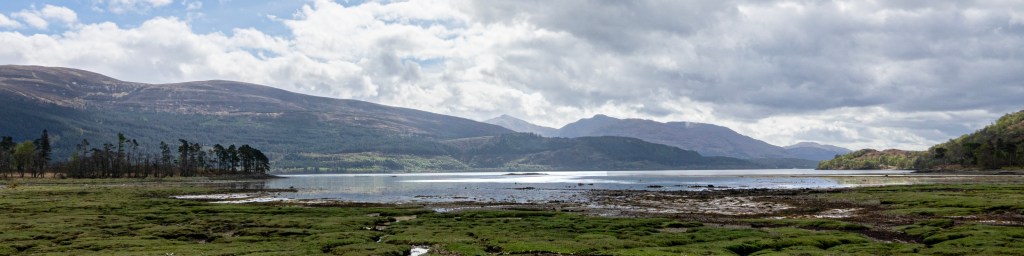
It’s time to turn our backs on Loch Linnhe, to leave the road at last. It’s a beautiful spot, tree-lined spits of land jutting into a great spread of water tranquil enough to hold on its surface the gamut of greys and blues, yellows and greens painted onto sky and ground. From our right, the River Scaddle empties into the loch, having already mopped up the contents of the River Cona. Over on the far, eastern side, dark lines of forestry cloak the low hills, while in the distance Bidean nam Bian, one of Glencoe’s great peaks, spears the clouds. But I hug the thought of turning north, heading away from places I know fairly well and heading into the new.
It’s getting on for one o’clock, so we’ve made good time, having left Camusnagaul just before 11. Despite the elation of walking away from the main road towards the hills, I’m feeling a little hot and dehydrated. Chrissie looks fresh as the proverbial daisy. At least I can enjoy the shade of an oakwood clustering round the estate road. It’s all very nice, a well-manicured place designed for pleasure, as so many Scottish estates are. But keeping like that takes a lot of work. A few estate houses peek through the trees. We reach one opposite a pond and debate whether or not it might actually be a holiday home, not really bothered enough to go for a closer look. We have far enough to walk as it is.
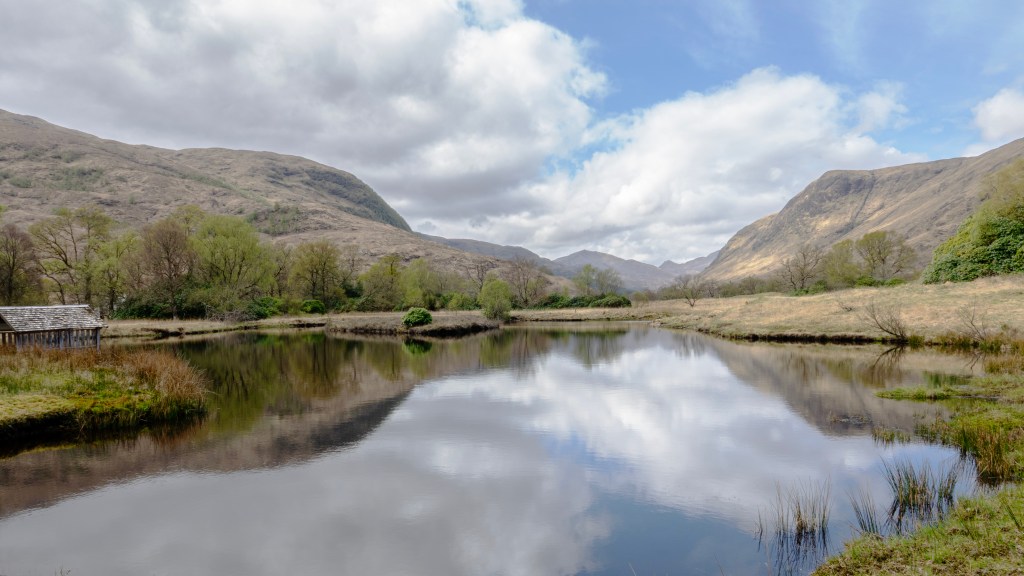
Chrissie has pulled out a snack on the go, but I really need to put down my pack and sort myself out. Taking off my jumper, I stuff it in next to my down jacket. That’s the problem with good weather; all your gear ends up in the rucksack, straining for space. Not that I’m complaining. I tease out two of my bars from their plastic bag, offering one to Chrissie. In between chomping, I take a few photos of the pond, nicely framed by a little wooden boathouse on the left pointing towards a cleft between the shoulders of two hills that reveals the mountains of Glen Scaddle beyond. A cormorant sits on the far bank straight ahead, enjoying a sunny place to fish.
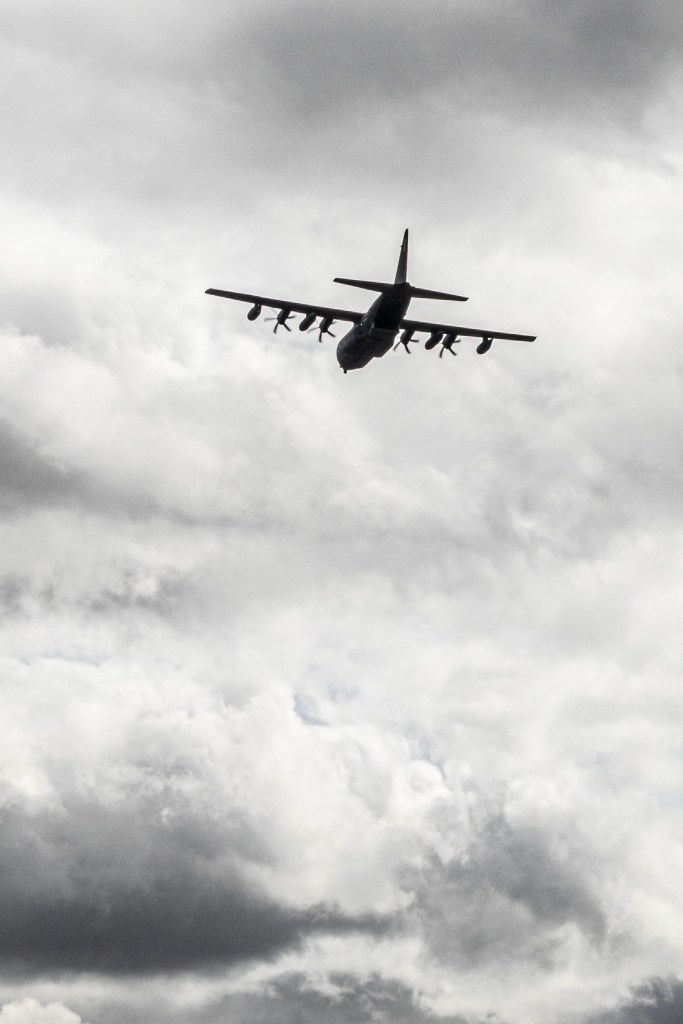
I gulp down several mouthfuls of water from my bottle, filled at home. I had thought about using a water purification kit for when I need to fill up from rivers, but after forty years in the Scottish hills, I’ve never bothered before, so I decided not to bother now. I’ve probably not drunk enough in this weather, but I don’t want to hold Chrissie back any longer. We’re not even half way yet. I brace myself to swing the pack onto my back just as a low roar hits us from up the glen. Skimming the trees, an enormous aircraft rumbles past, dark as shadow. We stand and watch, astonished to see it here, though these remote glens are no more inaccessible by air than they are by water. It’s only by road that they become difficult to reach. Perhaps it’s right that we should be reminded of the myriad of wars being fought around the globe even as we take ourselves far away from TV and the internet.
The oakwoods begin to thin, the track no longer tarmac but dry and easy underfoot. I turn my head. Yes, that’s definitely a cuckoo somewhere in the trees, announcing its presence to a potential mate with its unmistakeable two-note call, beginning its duplicitous journey to infiltrating its young into other birds’ nests while it jets off back to Africa. My first of the year. But I’ve only ever seen one, for all the many times I’ve heard them, so my camera stays in its case clipped onto the straps of my rucksack across my chest. We head off again.
[i] https://www.trove.scot/place/105855#activities
[ii] Macfarlane’s Geographical Collections, vol.2, 163.
[iii] Fitzroy Maclean, West Highland Tales (Edinburgh, 1985), p.85 onwards. This is the most colourful account, but the earliest – dating probably to around 1630 – is more prosaic, though providing the gist of the later story [Macfarlane’s Geographical Collections, p.163 and also at p.520]. A similar tale to that given by Fitzroy Maclean, and probably his source, is also to be found in J P Maclean’s History of Clan Maclean (Cincinnati, 1839), pp.45-6
[iv] Acts of the Lords of the Isles, 1336-1493, ed. Jean Munro and R W Munro (Edinburgh, 1986), p.138, p.123, p.128, p.148, p.161, p.164, p.185
[v] Allan Macinnes, Clanship, Commerce and the House of Stuart, 1603-1788 (East Linton, 1996), p.31. See also Allan Kennedy, Governing Gaeldom. The Scottish Highlands and the Restoration State, 1660-1668, (Leiden, 2014), pp.29-30


Leave a Reply